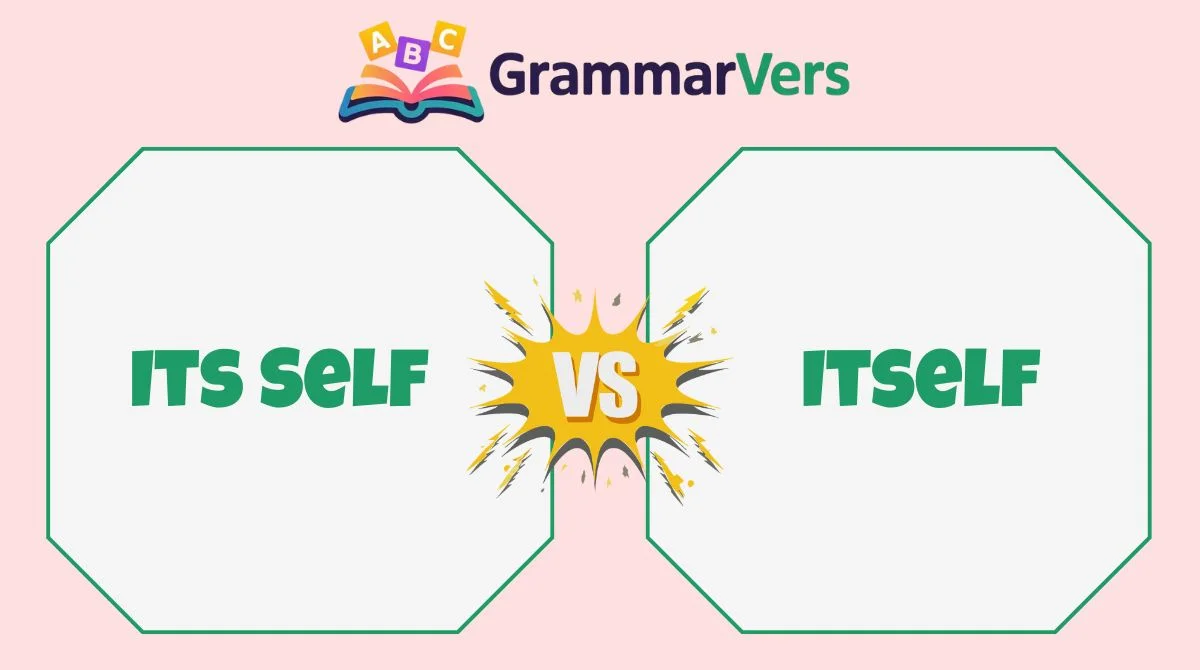
Many English learners feel confused when they see “its self” and “itself.” At first glance, both look similar. They have the same words, just written differently.
So, it’s easy to think they mean the same thing. But here’s the truth: one is correct in almost all situations, and the other is usually a mistake.
This confusion happens because English often joins words together. For example, “yourself,” “myself,” and “himself” are all one word. So naturally, learners wonder if “its self” should also be one word—or two.
Understanding this small difference is very important. These words appear in daily conversations, writing, exams, and even professional communication. Using the wrong form can make your sentence sound unnatural or incorrect.
After reading this guide, you will clearly understand:
- What “its self” really means (and why it’s rarely used)
- How “itself” works in sentences
- The exact difference between them
- Simple tricks to avoid mistakes forever
Everything is explained in easy English, with real-life examples, so you can feel confident using these words correctly.
What Does “Its Self” Mean?
“Its self” (two separate words) is not a standard form in modern English. In most cases, it is considered incorrect.
Simple Definition
“Its self” literally means:
- “its” (belonging to something)
- “self” (a noun meaning identity or nature)
So together, it could mean:
👉 “the self of it” or “its own nature”
However, this structure is rare and unnatural in everyday English.
When Is It Used?
“Its self” is only used in very rare, poetic, or philosophical writing. You might see it in:
- Old literature
- Deep philosophical discussions
- Highly formal or creative writing
In normal speaking and writing, people do NOT use “its self.”
Grammar Rule
- “Its” = possessive adjective (shows ownership)
- “Self” = noun
So “its self” is simply a noun phrase, not a reflexive pronoun.
Example Sentences (Rare Usage)
These examples are mostly for understanding—not for daily use:
- The machine has a mind of its self. ❌ (incorrect in modern English)
- The machine has a mind of its own. ✅ (correct)
- The idea developed a life of its self. ❌
- The idea developed a life of its own. ✅
- The system changed its self over time. ❌
- The system changed itself over time. ✅
- The creature acted by its self. ❌
- The creature acted by itself. ✅
Common Learner Confusion
Many learners write “its self” because:
- They think all “self” words are separate
- They translate directly from their native language
- They confuse it with “its own”
👉 Important: In modern English, you almost always need “itself,” not “its self.”
What Does “Itself” Mean?
“Itself” is a reflexive pronoun. It is the correct and commonly used form.
Simple Definition
“Itself” means:
👉 “the thing does something to its own self”
or
👉 “the same thing again for emphasis”
When to Use It
Use “itself” in two main situations:
1. Reflexive Action (the subject and object are the same)
The thing is doing something to itself.
2. Emphasis
To stress that something is acting alone or independently.
Grammar Rule
“Itself” = reflexive pronoun
Used when:
- Subject = object
OR - You want emphasis
Example Sentences
- The cat cleaned itself.
- The door closed itself.
- The phone turned itself off.
- The company rebuilt itself after the crisis.
- The baby hurt itself while playing.
- The computer restarted itself.
- The machine fixed itself automatically.
- The story explains itself clearly.
Common Learner Confusion
Learners often:
- Forget to use “itself” when needed
- Replace it with “its self”
- Mix it with “its” or “it’s”
👉 Quick note:
- “It’s” = it is
- “Its” = possession
- “Itself” = reflexive pronoun
Difference Between “Its Self” and “Itself”
Here is a clear comparison to help you understand:
| Feature | Its Self | Itself |
|---|---|---|
| Type | Possessive + noun | Reflexive pronoun |
| Usage | Rare, outdated | Common and correct |
| Meaning | “its own self” (theoretical) | action done to itself |
| Grammar role | Noun phrase | Object or emphasis |
| Used in daily English? | ❌ No | ✅ Yes |
| Example | Incorrect in modern use | Correct and natural |
Usage Difference
- ❌ Its self is almost never used
- ✅ Itself is used in daily speaking and writing
Grammar Logic
English reflexive pronouns are always one word:
- myself
- yourself
- himself
- herself
- itself
So “its self” breaks this pattern.
Sentence Structure Difference
- Incorrect: The dog hurt its self.
- Correct: The dog hurt itself.
Meaning Comparison
- “Itself” = action returns to the subject
- “Its self” = awkward and unclear in modern English
Grammar Rules You Must Remember
: Reflexive pronouns are always ONE word
Correct:
- The bird cleaned itself.
Incorrect:
- The bird cleaned its self.
: Use “itself” when subject = object
Correct:
- The robot repaired itself.
Explanation: The robot did the action to itself.
: Never replace “itself” with “its self”
Incorrect:
- The system updated its self.
Correct:
- The system updated itself.
: Use “its own” for possession, not “its self”
Incorrect:
- The company has a culture of its self.
Correct:
- The company has a culture of its own.
Common Mistakes Students Make
Why Mistakes Happen
- Confusion between “its,” “it’s,” and “itself”
- Direct translation from other languages
- Thinking all “self” words are separate
Common Errors and Fixes
❌ The dog looked at its self in the mirror.
✅ The dog looked at itself in the mirror.
❌ The machine repaired its self.
✅ The machine repaired itself.
❌ The idea grew by its self.
✅ The idea grew by itself.
Easy Correction Tips
- If you mean reflection → use “itself”
- If you can replace it with “alone” → use “itself”
- Never separate “it” and “self”
Easy Trick to Remember the Difference
Think of this simple rule:
👉 All “self” pronouns are ONE word.
- myself
- yourself
- himself
- herself
- itself
So if you see “its self,” your brain should say:
🚫 “Something is wrong!”
Real-Life Logic
Imagine saying:
- “my self” ❌
- “your self” ❌
You would never do that, right?
Same rule applies:
- “its self” ❌
- “itself” ✅
Daily Life Examples
These are simple sentences you can hear in everyday conversation:
- The door closed itself suddenly.
- My phone switched itself off.
- The baby can feed itself now.
- The system fixed itself overnight.
- The car stopped itself automatically.
- The app updated itself.
- The plant grows itself in sunlight.
- The story explains itself easily.
- The machine shut itself down.
- The cat cleaned itself after eating.
Practice Section
Choose the correct option:
- The dog hurt (its self / itself).
- The phone restarted (its self / itself).
- The machine fixed (its self / itself).
- The baby dressed (its self / itself).
- The system updated (its self / itself).
Answers
- itself
- itself
- itself
- itself
- itself
FAQs
1. What is the difference between “its self” and “itself”?
“Its self” is not used in modern English and is usually incorrect. “Itself” is a reflexive pronoun used when something acts on its own or for emphasis.
2. Can we use “its self” in any situation?
Almost never. It may appear in old or poetic writing, but in everyday English, you should always use “itself.”
3. Is “itself” formal or informal?
“Itself” is neutral. It is used in both formal and informal English.
4. Can “itself” be used in questions?
Yes.
Example:
- Did the machine fix itself?
5. What is the difference between “its” and “itself”?
“Its” shows possession (its color, its shape).
“Itself” shows action returning to the subject.
6. Why do learners confuse these words?
Because they look similar and learners often think “self” words are separate. Also, some languages do not follow the same pattern.
Final Conclusion
Understanding the difference between “its self” and “itself” is actually simpler than it first seems. The key idea is that “itself” is the correct and commonly used form, while “its self” is outdated and rarely used in modern English.
Once you remember that all reflexive pronouns are written as one word, this confusion disappears. Just follow the pattern: myself, yourself, himself, herself—and of course, itself.
The more you practice, the more natural it will feel. Try to notice how “itself” is used in conversations, books, and even apps you use daily. Then start using it in your own sentences.
Small grammar points like this can make a big difference in your English. Keep practicing, stay curious, and don’t worry about mistakes—they are part of learning.
You’re getting better step by step.