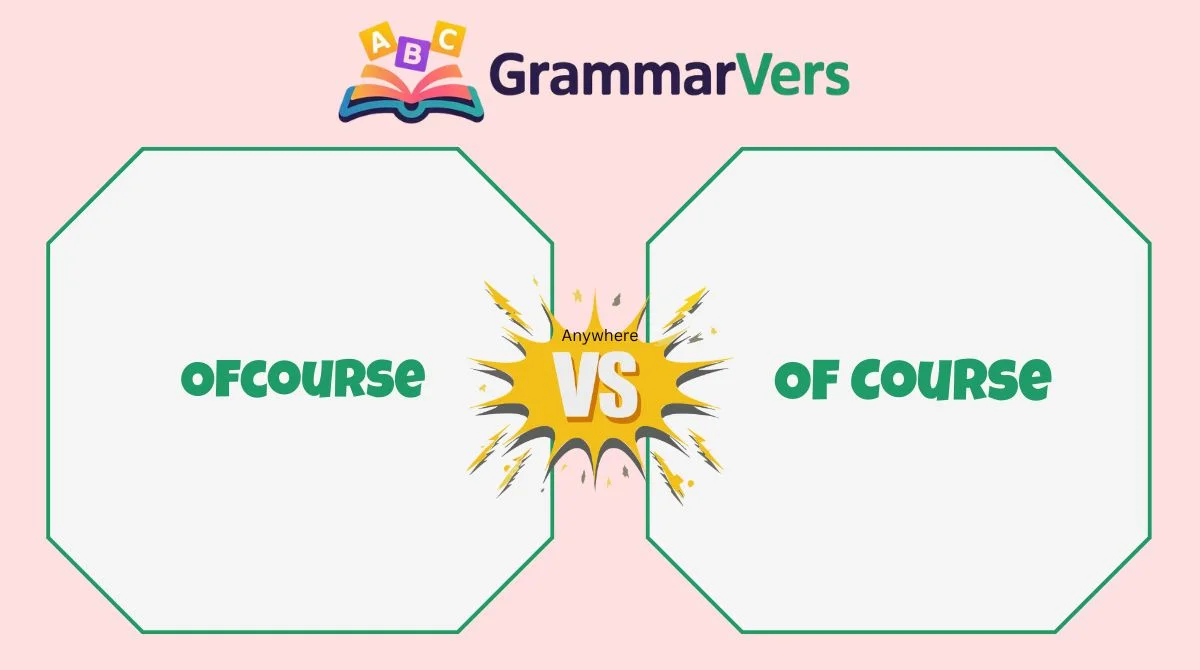
Many English learners feel confused when they see words that look similar but behave differently. One such confusing pair is “of course” and “ofcourse.”
At first glance, both seem correct. They sound the same when spoken. So it’s easy to think they are just two versions of the same word.
But here’s the truth: English spelling rules can be tricky, and small mistakes like this can change how people understand your writing.
In exams, emails, or even casual messages, using the wrong form may make your English look weak or unclear.
This topic is important because “of course” is a very common phrase. People use it every day in conversations. You will hear it in movies, classrooms, workplaces, and friendly chats.
So, knowing the correct form helps you sound natural and confident.
After reading this lesson, you will clearly understand:
- Which one is correct: of course or ofcourse
- How to use it properly in sentences
- Why learners make this mistake
- Easy tricks to remember it forever
By the end, you won’t feel confused again.
What Does “Of Course” Mean?
Simple Definition
“Of course” is a common English phrase. It means:
- Yes, definitely
- Naturally
- Without any doubt
It is used to show agreement, certainty, or something that is obvious.
When to Use It
You use “of course” when:
- You strongly agree with someone
- You want to say something is obvious
- You answer a question positively
- You want to sound polite and friendly
Grammar Rule
“Of course” is a two-word phrase:
- “of” = a preposition
- “course” = a noun
Together, they form a fixed expression. It must always be written as two separate words.
Example Sentences
- Of course I will help you with your homework.
- Can you come tomorrow? Of course!
- She is tired, of course. She worked all night.
- Of course we trust you.
- He will win, of course.
- Of course, you can sit here.
- Are you coming to the party? Of course I am.
- Of course this is the right answer.
Common Learner Confusion
Many students think:
- “It sounds like one word, so maybe it is one word.”
But English spelling does not always match pronunciation. Even though it sounds like “ofcourse,” it must be written as “of course.”
What Does “Ofcourse” Mean?
Simple Definition
“Ofcourse” is NOT a correct word in standard English.
It has no meaning because it is simply a spelling mistake.
When to Use It
You should never use “ofcourse” in:
- Exams
- Emails
- Essays
- Professional writing
- Formal or informal communication
Grammar Rule
There is no grammar rule for “ofcourse” because:
- It is not a recognized word
- It does not exist in English dictionaries
Example Sentences (Incorrect Usage)
These are wrong sentences:
- ❌ Ofcourse I will help you.
- ❌ Ofcourse she knows the answer.
- ❌ Can you do this? Ofcourse!
- ❌ Ofcourse we are ready.
- ❌ He will come, ofcourse.
- ❌ Ofcourse you can join us.
- ❌ Ofcourse it is correct.
- ❌ I will call you, ofcourse.
Correct Versions
- ✔ Of course I will help you.
- ✔ Of course she knows the answer.
- ✔ Of course!
- ✔ Of course we are ready.
Common Learner Confusion
Students often:
- Type quickly and join the words
- Think it’s like “maybe” or “always” (single words)
- Copy incorrect spelling from social media
But remember: just because you see it online does not mean it is correct.
Difference Between Of Course and Ofcourse (Detailed)
Comparison Table
| Feature | Of Course | Ofcourse |
|---|---|---|
| Correct spelling | ✅ Yes | ❌ No |
| Meaning | Yes, definitely | No meaning |
| Grammar | Fixed phrase | Not a word |
| Usage | Spoken & written English | Never used correctly |
| Dictionary presence | Yes | No |
Usage Difference
- Of course is used daily in English.
- Ofcourse should never be used.
Grammar Logic
“Of course” follows a simple rule:
- It is a phrase made of two words.
- Each word has its own function.
“Ofcourse” breaks this rule because:
- It incorrectly combines two separate words.
Sentence Structure Difference
Correct:
- Of course + subject + verb
→ Of course I understand.
Incorrect:
- Ofcourse + subject + verb
→ ❌ Ofcourse I understand.
Meaning Comparison
- “Of course” = clear meaning (certainty)
- “Ofcourse” = no meaning (error)
Grammar Rules You Must Remember
Rule #1: Always Write It as Two Words
✔ Of course I agree with you.
❌ Ofcourse I agree with you.
Rule #2: Use It to Show Strong Agreement
✔ Of course I will join the meeting.
This shows confidence and certainty.
Rule #3: Use It in Both Formal and Informal English
✔ Formal: Of course, we accept your proposal.
✔ Informal: Of course! No problem.
Rule #4: Comma Usage (Optional but Helpful)
When used at the beginning of a sentence, a comma can improve clarity.
✔ Of course, you can try again.
✔ You can try again, of course.
Common Mistakes Students Make
Why Mistakes Happen
- Fast typing on phones
- Hearing the phrase as one sound
- Lack of grammar awareness
- Influence of incorrect online content
Wrong vs Correct Examples
- ❌ Ofcourse I understand.
✔ Of course I understand. - ❌ Ofcourse she is happy.
✔ Of course she is happy. - ❌ Can you help me? Ofcourse.
✔ Can you help me? Of course.
Easy Correction Tips
- Always check spelling before sending messages
- Read your sentence slowly
- Remember: two words, not one
- Practice writing it correctly
Easy Trick to Remember the Difference
Here is a simple trick:
Think of “of course” as:
👉 “of + a course (path or direction)”
Even though the meaning is different, this idea helps you remember:
- There are two separate parts
- So it must be written as two words
Another easy trick:
👉 If you can pause slightly while speaking, it’s probably two words.
Say it slowly:
“Of… course…”
That small pause shows it is not one word.
Daily Life Examples (Very Important)
These are natural, real-life sentences:
- A: Can you help me?
B: Of course! - Of course I remember your birthday.
- A: Are you free tonight?
B: Of course I am. - Of course she was upset after hearing the news.
- A: Can I borrow your pen?
B: Of course. - Of course we need more time to finish this.
- A: Will you come with us?
B: Of course! - Of course he knows the answer.
- You can ask me anything, of course.
- Of course I trust you.
These are very common in daily conversations.
Practice Section
Choose the correct option:
- ______ I will call you later.
a) Ofcourse
b) Of course - Can you help me? ______
a) Of course
b) Ofcourse - ______ she is happy today.
a) Of course
b) Ofcourse - I understand your problem, ______.
a) of course
b) ofcourse - ______ we are ready to start.
a) Ofcourse
b) Of course
Answers
- b) Of course
- a) Of course
- a) Of course
- a) of course
- b) Of course
FAQs
1. What is the difference between “of course” and “ofcourse”?
“Of course” is correct and means “definitely” or “yes.” “Ofcourse” is incorrect and should never be used in proper English writing.
2. Can we use “of course” in questions?
Usually, “of course” is used in answers, not questions. But it can appear in questions for tone, like: “Of course you remember, right?”
3. Is “of course” formal or informal?
It can be both. It works in casual conversations and formal writing. The meaning stays the same.
4. Why do people write “ofcourse”?
Mostly because of fast typing or misunderstanding. It sounds like one word, so learners join it by mistake.
5. Is “of course” used in spoken English?
Yes, very often. It is one of the most common phrases in daily conversation.
6. Can “of course” be used at the end of a sentence?
Yes. Example: “You can join us, of course.” It sounds polite and natural.
Final Conclusion
Understanding the difference between of course and ofcourse is simple once you know the basic rule. Only “of course” is correct. It is a two-word phrase used to show agreement, certainty, or something obvious.
On the other hand, “ofcourse” is just a common spelling mistake and should be avoided in all types of writing.
This small detail can make a big difference in how your English looks and sounds. When you use correct spelling, people understand you better, and your writing feels more natural and confident.
The best way to remember is practice. Try using “of course” in your daily conversations and writing. Read it, write it, and speak it correctly. Over time, it will become automatic.
Keep learning step by step. Small improvements like this help you become a strong English speaker.