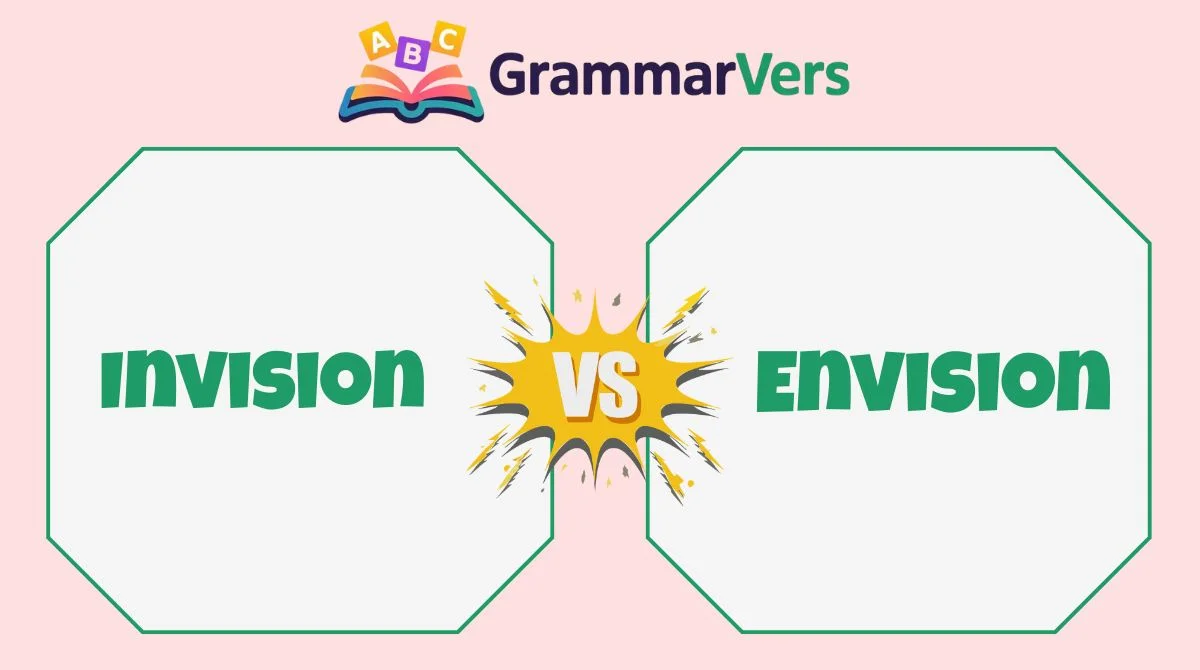
Many English learners feel confused when they see words that look almost the same. Invision and envision are a perfect example. At first glance, they seem like twins.
Same spelling pattern, same sound, and even similar meanings in some situations. So it’s easy to think both are correct and interchangeable.
But here’s the truth: one of these words is standard and widely accepted, while the other is rarely used and often considered incorrect in modern English.
This creates a lot of confusion, especially for students, writers, and non-native speakers who want to sound natural and accurate.
In daily conversations, emails, essays, and even job interviews, using the wrong word can make your English sound less confident. That’s why understanding the difference is important—not just for grammar, but for clear communication.
By the end of this guide, you will clearly understand what each word means, when to use it, which one is correct in modern English, and how to avoid common mistakes.
You’ll also get simple tricks and real-life examples to help you remember the difference easily.
What Does “Invision” Mean?
Simple Definition
Invision is not a standard English word in most modern dictionaries. It is often seen as a misspelling of “envision.”
However, in very rare cases, invision may appear as:
- A typing error
- A brand name (for example, software or companies)
- An outdated or incorrect variation
When to Use It
In general English writing and speaking, you should NOT use “invision.”
The only time it is acceptable:
- When referring to a proper name (like a company or product)
- When quoting someone’s exact words (including mistakes)
Grammar Rule
There is no formal grammar rule for invision because it is not recognized as a standard verb in modern English.
Example Sentences
These examples show how invision might appear, but notice that most are incorrect in normal usage:
- ❌ I invision a better future for us.
- ❌ Can you invision this idea clearly?
- ❌ She invisions success in her career.
- ❌ It’s hard to invision the result.
- ❌ Try to invision your dream life.
- ❌ He invisioned a new design.
✅ Correct version (with “envision”):
- I envision a better future for us.
Common Learner Confusion
Many learners think:
- “Invision” comes from “in” (inside) + “vision”
- So it must mean “to see inside your mind”
This idea sounds logical, but English doesn’t work that way here. The correct word is actually envision, not invision.
What Does “Envision” Mean?
Simple Definition
Envision means to imagine or picture something clearly in your mind, especially something in the future.
When to Use It
Use envision when you:
- Talk about plans or dreams
- Imagine future situations
- Describe ideas in your mind
Grammar Rule
- Envision is a verb
- It is commonly followed by:
- A noun
- A pronoun
- A verb in -ing form
Structure:
- Envision + noun → I envision success.
- Envision + -ing → I envision working abroad.
Example Sentences
- I envision a bright future for my family.
- She envisions herself as a doctor.
- Can you envision living in another country?
- They envision building a big company.
- He envisions success after hard work.
- We envision a peaceful world.
- I can’t envision doing that job every day.
- The teacher asked us to envision our goals.
Common Learner Confusion
Some learners confuse envision with:
- Imagine
- Visualize
While they are similar, envision is often used for:
- Future ideas
- Goals
- Plans
Difference Between Invision and Envision (Detailed)
Quick Comparison Table
| Feature | Invision | Envision |
|---|---|---|
| Correct word? | ❌ No | ✅ Yes |
| Meaning | None (usually incorrect) | To imagine or picture something |
| Usage | Not used in standard English | Common in writing & speech |
| Grammar role | Not valid | Verb |
| Common mistake | Misspelling of envision | Used correctly |
Usage Difference
- Invision is usually a mistake.
- Envision is the correct word used by native speakers.
Grammar Logic
English uses prefixes carefully:
- “En-” often means to cause or put into
- Example: enable, enrich
So, envision means:
👉 “to form a vision in your mind”
Sentence Structure Difference
❌ Incorrect:
- I invision success.
✅ Correct:
- I envision success.
Meaning Comparison
- Invision: No real meaning in modern English
- Envision: Clear mental picture of something, especially future plans
Grammar Rules You Must Remember
: Always Use “Envision” (Not Invision)
✔ Correct: I envision success.
❌ Wrong: I invision success.
: Use “Envision” for Future Ideas
✔ She envisions becoming a lawyer.
: Use “-ing” Form After Envision
✔ I envision working abroad.
: Use It for Mental Images, Not Physical Sight
✔ I envision a better life.
❌ I envision the car in front of me.
Common Mistakes Students Make
Why Mistakes Happen
- Words look similar
- Sound is almost the same
- Misunderstanding prefixes
Wrong vs Correct Examples
❌ I invision my future clearly.
✔ I envision my future clearly.
❌ Can you invision this plan?
✔ Can you envision this plan?
Easy Correction Tips
- If you write “invision,” stop and check
- Replace it with “envision”
- Practice saying the correct form aloud
Easy Trick to Remember the Difference
Think of this:
👉 “Envision = Enter your vision”
- “En” sounds like “enter”
- So, envision means:
→ entering your mind
→ seeing something in your imagination
If you remember this idea, you’ll never use invision again.
Daily Life Examples (Very Important)
Here are simple sentences you might hear in real conversations:
- I envision myself traveling the world.
- She envisions a happy family life.
- Can you envision living here?
- He envisions starting his own business.
- We envision better days ahead.
- I can’t envision doing that job.
- They envision success after graduation.
- She envisions becoming famous.
- I envision a calm and peaceful life.
- Do you envision your future clearly?
Practice Section
Choose the correct word:
- I ______ my dream life.
- She ______ becoming a doctor.
- Can you ______ this idea?
- They ______ a better future.
- He ______ working abroad.
Answers
- envision
- envisions
- envision
- envision
- envisions
FAQs
1. What is the difference between invision and envision?
Invision is usually a spelling mistake, while envision is the correct word meaning “to imagine something clearly.” Only envision is used in standard English.
2. Can we use “invision” in sentences?
No, it is not correct in normal English writing. You should always use envision unless it is a brand name or a quoted mistake.
3. Is “envision” formal or informal?
Envision is neutral. It can be used in both formal writing and everyday conversation.
4. Can “envision” be used in questions?
Yes, absolutely.
Example: Can you envision your future clearly?
5. Is “envision” the same as “imagine”?
They are similar, but envision is often used for future plans and goals, while imagine is more general.
6. Why do people write “invision” instead of “envision”?
Because the words sound similar. Many learners think “in” is the correct prefix, but English actually uses “en” in this case.
Final Conclusion
Understanding the difference between invision and envision is simpler than it first seems. One is a common mistake, and the other is the correct and widely used word. Once you know this, half the confusion disappears.
The key point to remember is that envision is the word you need when talking about ideas, dreams, and future plans. It helps you express thoughts clearly and naturally in English.
On the other hand, invision is best avoided unless you are referring to a name or correcting someone’s error.
Language learning becomes easier when you focus on small details like this. These tiny improvements can make a big difference in how confident and natural your English sounds.
Keep practicing with real-life sentences, use the word in your daily conversations, and soon it will feel completely natural. Over time, you won’t even think twice—you’ll just know the right word to use.