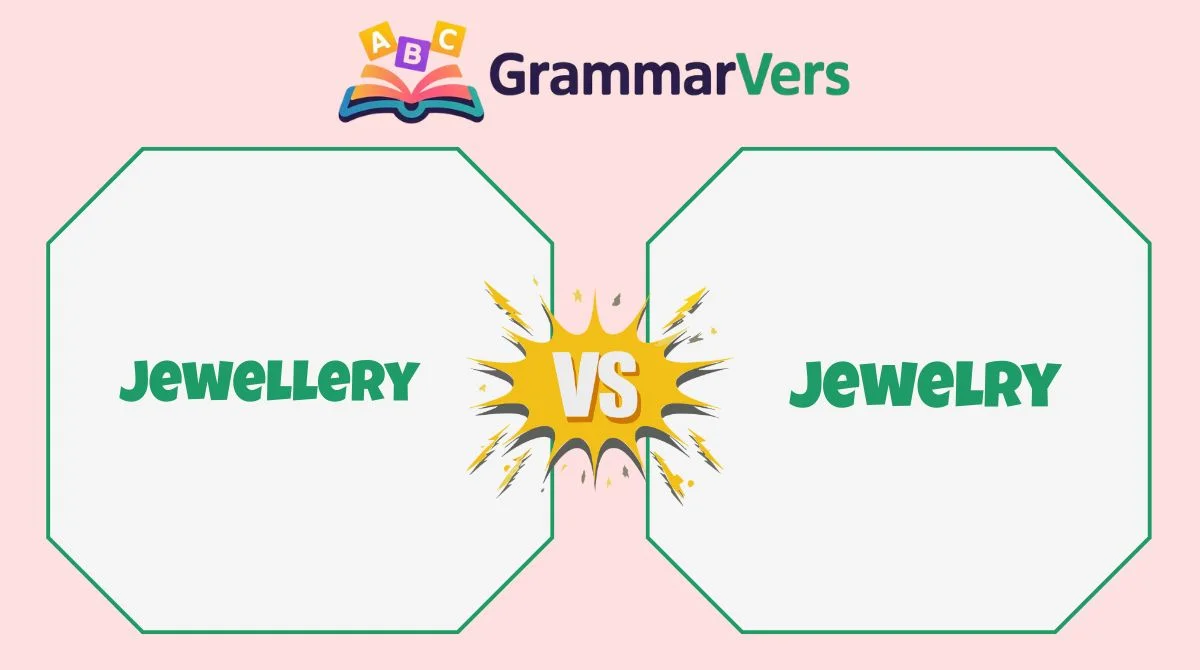
Many English learners feel confused when they see two spellings for the same word: jewelry and jewellery.
You might wonder, “Which one is correct?” or “Am I making a mistake if I use the wrong one?” This confusion is very common, especially for students who learn English from different sources like books, movies, or social media.
The truth is simple, but it often surprises learners. Both words are correct. Yes, both! The difference is not about meaning or grammar in the usual sense.
It is about where the English is used—mainly American English and British English.
Understanding this small difference can make a big improvement in your writing. It helps you sound more natural and confident.
It also helps you match your English with your audience, whether you are writing for school, work, or online.
By the end of this lesson, you will clearly understand:
- The meaning of both words
- Why there are two spellings
- When to use each one
- How to avoid common mistakes
This topic may look small, but it is very useful in real-life English. Let’s make it simple and clear.
What Does “Jewelry” Mean?
Jewelry is a noun. It means decorative items that people wear on their body. These items are usually made of gold, silver, diamonds, or other precious materials.
Common examples of jewelry include:
- Rings
- Necklaces
- Bracelets
- Earrings
When to Use “Jewelry”
You use jewelry when you are following American English spelling. This is common in countries like:
- The United States
- Canada (sometimes mixed)
If you are writing for an American audience, this is the correct spelling.
Grammar Rule
“Jewelry” is an uncountable noun. This means:
- You do NOT say: a jewelry
- You say: a piece of jewelry
Example Sentences
- She bought beautiful jewelry for her wedding.
- I love simple gold jewelry.
- He gave her a piece of jewelry on her birthday.
- This store sells handmade jewelry.
- She lost her favorite jewelry yesterday.
- My mother keeps her jewelry in a small box.
- They design modern jewelry for young people.
- I don’t wear expensive jewelry every day.
Common Learner Confusion
Many learners think “jewelry” is plural because it talks about many items. But it is not plural. It is a collective noun.
❌ Incorrect: I bought many jewelries.
✅ Correct: I bought a lot of jewelry.
What Does “Jewellery” Mean?
Jewellery has the same meaning as jewelry. It refers to decorative items that people wear, like rings, necklaces, and bracelets.
When to Use “Jewellery”
You use jewellery in British English. This spelling is common in:
- The United Kingdom
- Australia
- India
- Pakistan
- Many other countries
If your school or country follows British English, this is the correct spelling for you.
Grammar Rule
Just like “jewelry,” jewellery is also an uncountable noun.
So:
- ❌ Not: a jewellery
- ✅ Yes: a piece of jewellery
Example Sentences
- She loves wearing traditional jewellery.
- I bought some silver jewellery from the market.
- His shop sells handmade jewellery.
- She keeps her jewellery in a safe place.
- This jewellery is very expensive.
- I don’t like heavy jewellery.
- They gifted her gold jewellery for the wedding.
- My sister designs beautiful jewellery.
Common Learner Confusion
Some students mix both spellings in one sentence or paragraph.
❌ Incorrect: I love jewellery, but this jewelry is expensive.
✅ Correct: I love jewellery, but this jewellery is expensive.
Stick to one style.
Difference Between Jewelry and Jewellery (Detailed)
Here is a clear comparison:
| Feature | Jewelry | Jewellery |
|---|---|---|
| Spelling Type | American English | British English |
| Meaning | Same | Same |
| Usage Area | USA | UK, Pakistan, India, etc. |
| Pronunciation | Same | Same |
| Grammar Type | Uncountable noun | Uncountable noun |
Usage Difference
The only real difference is spelling, not meaning.
- If you write for an American audience → use jewelry
- If you write for a British audience → use jewellery
Grammar Logic
Both words:
- Are uncountable
- Do not have a plural form
- Use “piece of” for counting
Sentence Structure Difference
There is no difference in structure:
- I bought jewelry.
- I bought jewellery.
Both are correct, depending on your English style.
Meaning Comparison
There is zero difference in meaning. Both refer to the same items.
Grammar Rules You Must Remember
Rule #1: It is an Uncountable Noun
You cannot count it directly.
✅ Correct: She has a lot of jewelry.
❌ Incorrect: She has many jewelries.
Rule #2: Use “Piece of” for Counting
If you want to count, use a helper phrase.
✅ Correct: I bought three pieces of jewellery.
❌ Incorrect: I bought three jewelleries.
Rule #3: Do Not Mix Spellings
Stay consistent in one style.
✅ Correct: This jewellery is beautiful.
❌ Incorrect: This jewelry is beautiful (in British writing).
Rule #4: Follow Your Audience
Choose the spelling based on who will read your writing.
✅ Example:
- American blog → jewelry
- British exam → jewellery
Common Mistakes Students Make
1. Adding “-s” to Make It Plural
❌ Wrong: I have many jewelries.
✅ Right: I have a lot of jewelry.
Why this happens:
Students think “many items = plural word.” But English doesn’t always work like that.
2. Mixing Both Spellings
❌ Wrong: This jewellery shop sells fine jewelry.
✅ Right: This jewellery shop sells fine jewellery.
Tip: Choose one style and stay with it.
3. Using “a jewelry”
❌ Wrong: She bought a jewelry.
✅ Right: She bought a piece of jewelry.
4. Thinking They Are Different Things
Some learners think:
- jewelry = modern
- jewellery = traditional
This is not true. Both mean the same.
Easy Trick to Remember the Difference
Here’s a simple trick:
- Jewelry (shorter spelling) → used in American English
- Jewellery (longer spelling) → used in British English
Think of it like this:
👉 British English often uses longer spellings
Examples:
- colour (UK) vs color (US)
- favourite (UK) vs favorite (US)
So:
- jewellery = British
- jewelry = American
This trick works in many cases.
Daily Life Examples (Very Important)
Here are simple, real-life sentences you may hear in daily English:
- I don’t wear jewelry every day.
- She bought new jewellery for the party.
- This jewelry looks expensive.
- My mother loves gold jewellery.
- Where did you buy this jewelry?
- He gave her jewelry as a gift.
- I lost my favourite piece of jewellery.
- Do you like silver jewelry or gold?
- That shop sells handmade jewellery.
- She keeps her jewelry in a box.
These are natural and commonly used in conversation.
Practice Section
Choose the correct option:
- She bought some beautiful (jewelry / jewellery).
- I have many (jewelries / pieces of jewelry).
- This (jewellery / jewelry) is very expensive.
- He gave her a (jewelry / piece of jewellery).
- That shop sells handmade (jewelries / jewellery).
Answers
- jewelry/jewellery (both correct depending on style)
- pieces of jewelry
- jewellery/jewelry
- piece of jewellery
- jewellery
FAQs
1. What is the difference between jewelry and jewellery?
There is no difference in meaning. The only difference is spelling. “Jewelry” is American English, while “jewellery” is British English.
2. Can we use jewelry in questions?
Yes, you can use it in questions.
Example:
Do you like jewelry?
It works just like any other noun.
3. Is jewellery formal or informal?
It is neutral. You can use it in both formal and informal situations. The choice depends on British or American spelling.
4. Can I use both spellings in one article?
No, it is better to use one spelling style. Mixing both can confuse readers and look unprofessional.
5. Why are there two spellings?
English has different versions. American and British English developed differently over time, so some words have different spellings.
6. Which spelling should I learn?
Learn the one used in your country or school system. If unsure, British English (jewellery) is common in many countries outside the USA.
Final Conclusion
The difference between jewelry and jewellery is much simpler than it looks. Both words mean the same thing and follow the same grammar rules. The only difference is spelling, based on American or British English.
Remember a few key points. These words are uncountable, so you cannot add “-s.” Always use phrases like “a piece of jewelry” when counting. Also, choose one spelling style and stay consistent in your writing.
Small details like this can make your English look clean and professional. They also help you connect better with your audience.
Keep practicing with real sentences. Notice how these words appear in books, websites, and conversations. Over time, choosing the correct spelling will become natural.
Language learning is about small steps. This is one of them, and now you understand it clearly.