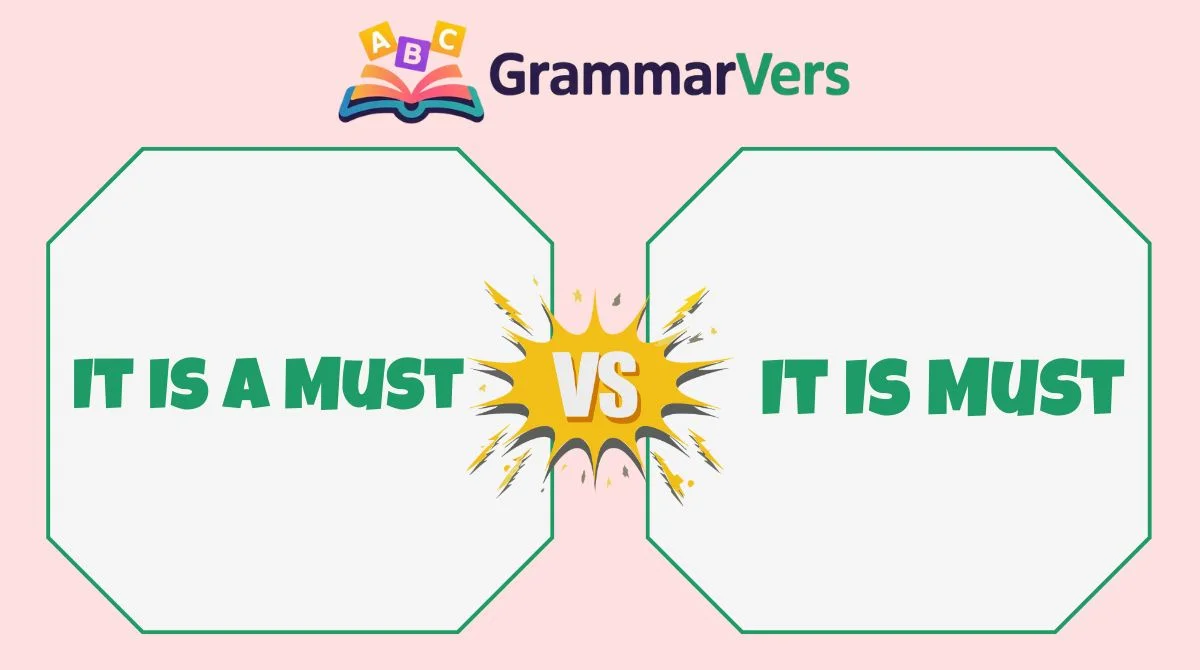
Many English learners feel confused when they see sentences like “It is must” and “It is a must.” At first glance, both look similar.
The words are almost the same, so it feels like both should be correct. But in real English, only one of them is correct.
This confusion happens because learners often translate directly from their native language. In many languages, we can say something like “It is must” without using an article.
But English works differently. Small words like a, an, and the can completely change whether a sentence sounds natural or wrong.
Understanding this topic is very important for daily English. You will hear phrases like “It’s a must” in conversations, movies, and even at work.
If you use the wrong form, people may still understand you, but your English may sound unnatural.
After reading this lesson, you will clearly understand:
- Why “It is must” is incorrect
- Why “It is a must” is correct
- How to use similar expressions properly
- How to avoid common mistakes
By the end, this confusion will feel very simple and easy.
What Does “It Is Must” Mean?
Simple Definition
“It is must” does not have a correct meaning in English. It is grammatically incorrect.
When to Use It
You should not use “it is must” at all in proper English.
Grammar Rule
The word “must” is a modal verb, not a noun in this structure.
Modal verbs include:
- must
- should
- can
- may
These verbs are used like this:
- You must go
- She must study
- We must leave
But they cannot be used after “is” like a noun.
Incorrect Structure
❌ It is must go
❌ It is must finish this
❌ It is must for you
These sentences are wrong because:
- “Must” is not being used correctly
- The sentence structure is broken
Correct Use of “Must”
Use “must” like this:
✔ You must finish your work
✔ She must be careful
✔ We must leave early
✔ He must study for the exam
✔ They must follow the rules
✔ I must call my friend
✔ You must not forget this
✔ Students must respect teachers
Common Learner Confusion
Many learners think:
“Must means something is important, so I can say ‘It is must’.”
This is incorrect because:
- “Must” is a verb, not a noun
- After “is,” we usually need a noun or adjective, not a modal verb
So, “It is must” simply does not fit English grammar rules.
What Does “It Is a Must” Mean?
Simple Definition
“It is a must” means:
👉 Something is very important or necessary
When to Use It
Use this phrase when:
- Something is required
- Something is highly recommended
- Something is essential
Grammar Rule
Here, “must” is used as a noun, not a verb.
Structure:
👉 It + is + a + noun
In this case:
- “must” becomes a noun meaning “something necessary”
- “a” is needed because it is a countable noun
Example Sentences
✔ It is a must to wear a helmet while riding a bike
✔ Drinking water daily is a must
✔ This book is a must for beginners
✔ It’s a must to arrive on time
✔ Exercise is a must for good health
✔ Learning basic English is a must today
✔ This movie is a must-watch
✔ Respect is a must in any relationship
Common Learner Confusion
Some learners ask:
“Why do we need ‘a’ here?”
Because:
- “Must” is acting as a singular countable noun
- In English, singular countable nouns need an article (a/an)
Without “a,” the sentence becomes incorrect:
❌ It is must
✔ It is a must
Difference Between “It Is Must” and “It Is a Must” (Detailed)
Comparison Table
| Feature | It Is Must | It Is a Must |
|---|---|---|
| Correct or Incorrect | ❌ Incorrect | ✔ Correct |
| Grammar Type | Wrong structure | Proper noun phrase |
| Use of “must” | Modal verb (wrong use) | Noun (correct use) |
| Needs article? | Not applicable | Yes (“a”) |
| Meaning | No meaning | Something necessary |
Usage Difference
- “It is must” is not used in English
- “It is a must” is commonly used in both spoken and written English
Grammar Logic
- “Must” as a verb → cannot follow “is” directly
- “Must” as a noun → needs “a”
Correct logic:
✔ It is + a + must
Sentence Structure Difference
Incorrect:
❌ It is must finish this
Correct:
✔ You must finish this
✔ It is a must to finish this
Meaning Comparison
- “It is must” → no meaning
- “It is a must” → something is very important
Grammar Rules You Must Remember
Rule #1: “Must” as a modal verb cannot follow “is”
❌ It is must go
✔ You must go
Rule #2: Use “a” when “must” is a noun
✔ It is a must to study daily
Rule #3: Use “must” directly with a subject
✔ I must work
✔ She must call me
Rule #4: Use “It is a must” for general importance
✔ It is a must to stay healthy
✔ It’s a must to follow rules
Common Mistakes Students Make
Why Mistakes Happen
- Direct translation from native language
- Not understanding articles (a, an, the)
- Confusion between verbs and nouns
Mistake #1
❌ It is must to wear a mask
✔ It is a must to wear a mask
Tip: Always check if a noun needs “a”
Mistake #2
❌ It is must study hard
✔ You must study hard
Tip: Use “must” as a verb with a subject
Mistake #3
❌ It is must for success
✔ It is a must for success
Tip: If “must” describes importance → use “a must”
Mistake #4
❌ It is must to exercise
✔ It is a must to exercise
Tip: Never skip the article “a”
Easy Trick to Remember the Difference
Here’s a simple trick:
👉 If you can replace “must” with “necessary thing,” then use “a must”
Example:
- It is a must → It is a necessary thing ✔
👉 If you want to give a command, use “must” as a verb
Example:
- You must go ✔
Real-Life Logic
Think like this:
- “Must” alone = action (verb)
- “A must” = thing (noun)
This small idea can solve the confusion forever.
Daily Life Examples (Very Important)
Here are natural spoken English examples:
- It’s a must to drink water in summer
- Wearing a seatbelt is a must
- This app is a must for students
- It’s a must to respect elders
- You must finish your homework today
- I must wake up early tomorrow
- It’s a must to save money
- Exercise is a must for fitness
- You must not ignore this problem
- It’s a must to stay calm in stress
These are common in everyday conversations.
Practice Section
Choose the correct option:
- It is ___ to follow the rules
a) must
b) a must - You ___ complete this work
a) must
b) a must - Exercise is ___ for health
a) must
b) a must - It is ___ wear a helmet
a) must
b) a must - We ___ respect others
a) must
b) a must
Answers
- b) a must
- a) must
- b) a must
- b) a must
- a) must
FAQs
1. What is the difference between “it is must” and “it is a must”?
“It is must” is grammatically incorrect and not used in English. “It is a must” is correct and means something is necessary or very important.
2. Can we use “it is must” in any situation?
No, it is always incorrect. You should never use “it is must” in proper English.
3. Is “it is a must” formal or informal?
“It is a must” can be used in both formal and informal situations. It is common in daily conversation and writing.
4. Can I say “must” without “a”?
Yes, but only when used as a verb. For example: “You must study.”
When used as a noun, you must say “a must.”
5. Why do we use “a” before “must”?
Because “must” becomes a countable noun in this phrase. In English, singular countable nouns need an article like “a.”
6. Is “must” always a verb?
No. “Must” is usually a modal verb, but in phrases like “a must,” it works as a noun.
Final Conclusion
The difference between “it is must” and “it is a must” is simple once you understand the role of the word “must.” One is incorrect, and the other is a common and useful English expression.
“It is must” does not follow any correct grammar rule, so it should be avoided completely. On the other hand, “it is a must” is widely used to show that something is important or necessary.
The key idea is to understand whether “must” is being used as a verb or a noun. When it acts like a noun, it needs “a.” When it is a verb, it should be used with a subject like “you” or “I.”
Keep practicing with real-life examples. Try to use “it’s a must” in your daily conversations. Over time, it will feel natural, and you won’t even think about the rule.
Small grammar points like this can make a big difference in your English. Stay curious, keep learning, and your confidence will grow step by step.