Many English learners feel confused when they hear phrases like “much better.” It sounds natural in conversations, but at the same time, it can feel a little strange.
Why do we use “much” with “better”? Can we say “very better”? Is there a rule behind this?
These questions are very common, especially for beginners and intermediate students. The confusion usually comes from mixing up how adverbs work with comparative adjectives.
Words like very, much, and so seem similar, but they are not always used in the same way.
This topic is important because phrases like “much better” are used every day in spoken English. You hear them in conversations, movies, classrooms, and even at work.
If you use the wrong word, your sentence may sound unnatural or incorrect.
After reading this guide, you will clearly understand:
- What “much” and “better” mean
- Why “much better” is correct
- Why “very better” is wrong
- How to use these words naturally in daily English
By the end, you will feel confident using this phrase in your own sentences without hesitation.
What Does “Much” Mean?
Simple Definition
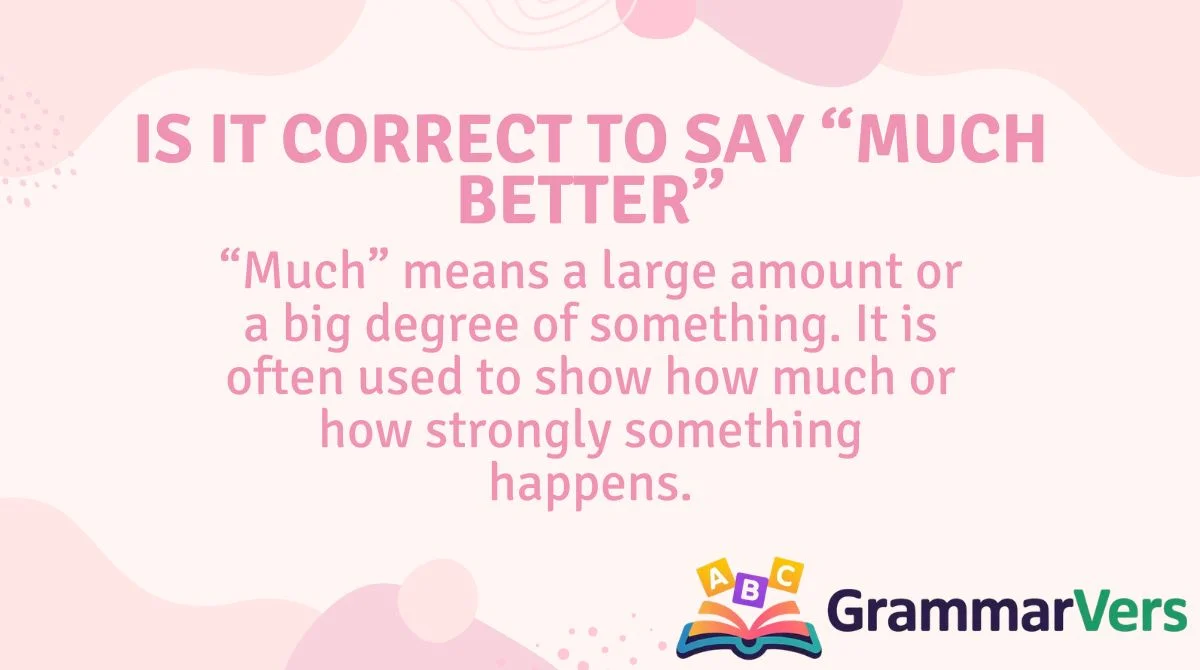
“Much” means a large amount or a big degree of something. It is often used to show how much or how strongly something happens.
When to Use It
“Much” is used:
- With uncountable nouns (like water, time, money)
- To show degree (how much something changes or improves)
- Before comparative adjectives (like better, faster, easier)
Grammar Rule
“Much” is commonly used before comparative adjectives to make the comparison stronger.
Structure:
- much + comparative adjective
Example: much better, much faster, much easier
Example Sentences
- I don’t have much time today.
- There isn’t much water left in the bottle.
- This phone is much cheaper than the other one.
- Your English is much better now.
- This road is much longer than I thought.
- She feels much happier after the good news.
- The second test was much easier.
- This method works much faster.
Common Learner Confusion
Many learners think “much” is only used with negative sentences:
- I don’t have much money.
That’s true in some cases, but “much” is also used in positive sentences when showing comparison:
- This is much better.
This is where students often get confused.
What Does “Better” Mean?
Simple Definition
“Better” is the comparative form of “good.” It means something is more good than something else.
When to Use It
Use “better” when you are comparing two things:
- One thing is more good than another
Grammar Rule
“Better” is an irregular comparative adjective.
- good → better → best
Structure:
- Subject + is/are + better (than…)
Example Sentences
- This book is better than the last one.
- She sings better than her sister.
- Today is better than yesterday.
- I feel better after resting.
- This restaurant is better than the one near my house.
- His idea is better than mine.
- Life is getting better.
- Your writing is better now.
Common Learner Confusion
Some learners try to say:
- ❌ more better
This is incorrect because “better” already means “more good.” You don’t need “more” again.
Another confusion:
- ❌ very better
This is also incorrect because “very” is not used with comparative adjectives.
Difference Between “Much” and “Better” (Detailed)
Even though “much” and “better” often appear together, they have very different roles.
Comparison Table
| Feature | Much | Better |
|---|---|---|
| Type | Adverb / determiner | Comparative adjective |
| Meaning | A large degree or amount | More good |
| Usage | Adds strength to comparison | Shows comparison |
| Can stand alone? | Sometimes | Yes |
| Example | much faster | This is better |
Usage Difference
- “Better” tells us which thing is superior
- “Much” tells us how big the difference is
Example:
- This phone is better. (simple comparison)
- This phone is much better. (strong comparison)
Grammar Logic
“Better” is already a comparative form.
“Much” is used to intensify or strengthen that comparison.
So:
- “better” = comparison
- “much better” = stronger comparison
Sentence Structure Difference
- Basic: Subject + is + better
- Stronger: Subject + is + much better
Examples:
- This plan is better.
- This plan is much better.
Meaning Comparison
- “Better” → improvement
- “Much better” → big improvement
Grammar Rules You Must Remember
Rule #1: Use “much” with comparative adjectives
✔ This is much easier.
✔ He is much taller than me.
“Much” makes the comparison stronger.
Rule #2: Never use “very” with “better”
❌ very better
✔ much better
“Very” is used with normal adjectives:
- very good
- very fast
But not with comparatives.
Rule #3: Do not use “more” with “better”
❌ more better
✔ better
“Better” already includes the idea of “more.”
Rule #4: Use “much” when the difference is big
✔ This movie is much better than the first one.
If the difference is small, you can just say:
✔ This movie is better.
Common Mistakes Students Make
Why Mistakes Happen
Students often translate directly from their native language. In many languages, adding words like “very” or “more” feels natural. But English has its own rules.
Mistake 1: Using “very better”
❌ This is very better.
✔ This is much better.
Tip: Remember — “very” + adjective, but NOT with comparatives.
Mistake 2: Using “more better”
❌ This is more better.
✔ This is better.
Tip: Never double the comparison.
Mistake 3: Not using “much” when needed
❌ This is better (when difference is big)
✔ This is much better
Tip: Use “much” to show a big difference.
Mistake 4: Overusing “much”
❌ Everything is much better (even small changes)
Sometimes simple “better” is enough.
Easy Trick to Remember the Difference
Here’s a simple way to remember:
👉 “Better” = comparison
👉 “Much” = how big the comparison is
Think of it like this:
- “Better” = improvement
- “Much better” = BIG improvement
Real-life idea:
If your headache is gone:
- I feel better.
If your headache was very bad and now you feel great:
- I feel much better.
So just ask yourself:
👉 Is the change small or big?
Daily Life Examples (Very Important)
Here are some natural, real-life sentences:
- I feel much better after taking medicine.
- This new phone is much better than my old one.
- Your English sounds much better now.
- This road is much better than the other one.
- I like this design much better.
- The weather is much better today.
- This job is much better for me.
- He looks much better after resting.
- This solution is much better than the first idea.
- Life is much better when you stay positive.
These are common in daily conversations.
Practice Section
Choose the correct option:
- This book is ___ than the last one.
a) very better
b) better
c) more better - I feel ___ after sleeping.
a) much better
b) very better
c) more better - This plan is ___ than yours.
a) better
b) very better
c) much good - This phone is ___ than my old one.
a) much better
b) very better
c) more better - Today is ___ than yesterday.
a) better
b) very better
c) more better
Answers
- b) better
- a) much better
- a) better
- a) much better
- a) better
FAQs
1. Is it correct to say “much better”?
Yes, it is completely correct. “Much better” is commonly used to show a strong improvement or big difference.
2. What is the difference between “better” and “much better”?
“Better” shows improvement. “Much better” shows a bigger or stronger improvement.
3. Can we use “very better”?
No, this is incorrect. “Very” is not used with comparative adjectives like “better.”
4. Can we use “much” in questions?
Yes, but usually with nouns or comparisons.
Example: Is this much better?
5. Is “much better” formal or informal?
It is used in both formal and informal English. It is very natural in everyday speech.
6. Why do we not say “more better”?
Because “better” already means “more good.” Adding “more” makes it incorrect.
Final Conclusion
So, is it correct to say “much better”? Yes, absolutely. It is not only correct but also very common in everyday English. It helps you express a stronger comparison and makes your sentences sound more natural.
The key idea is simple: “better” shows improvement, while “much better” shows a bigger improvement. Once you understand this, everything becomes easier.
Just remember a few important rules: never use “very better” or “more better,” and use “much” only when you want to show a strong difference.
Practice using these phrases in daily conversations. Try speaking simple sentences like “I feel much better” or “This is much better.” The more you use them, the more natural they will feel.
Keep learning step by step, and your English will keep getting better — or even much better.