Many English learners struggle with words that look almost the same but have very different meanings—or in some cases, one of them isn’t even a real word.
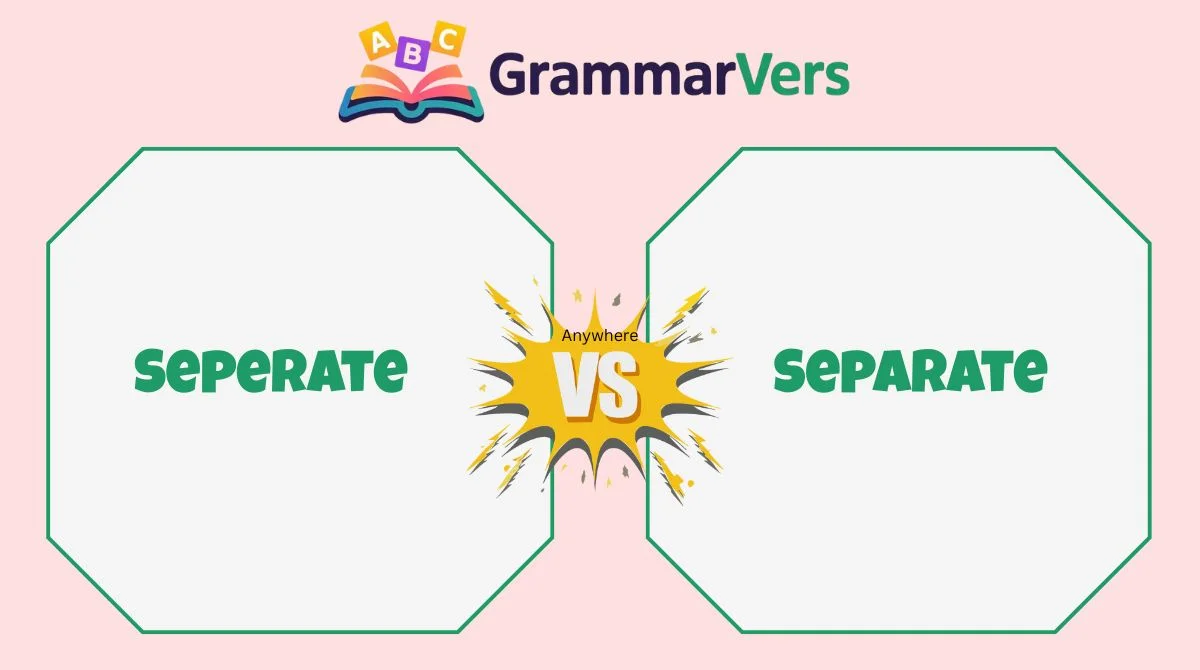
One of the most common examples is separate and seperate. These two spellings confuse students at all levels, especially beginners and non-native speakers.
The problem usually comes from pronunciation. When we say the word out loud, it sounds like “sep-uh-rate,” which makes many people think the spelling should include an “e” in the middle.
That’s how seperate appears. It feels correct, but it’s actually not.
This confusion matters more than you might think. Spelling mistakes like this can make your writing look unprofessional.
Whether you’re writing emails, school assignments, or even social media posts, correct spelling builds trust and clarity.
After reading this, you’ll clearly understand:
- Which spelling is correct
- Why the mistake happens
- How to use the correct word with confidence
- A simple trick to remember it forever
By the end, you won’t second-guess yourself again when writing this word.
What Does “Separate” Mean?
“Separate” is the correct spelling. It is both a verb and an adjective.
Simple Definition:
- As a verb: to divide or split things
- As an adjective: not together; different
When to Use It:
Use separate when you want to talk about dividing things, keeping things apart, or describing things that are not connected.
Grammar Rule:
- As a verb, it shows an action: to separate
- As an adjective, it describes something: separate rooms
Example Sentences:
- Please separate the white clothes from the colored ones.
- They decided to separate after many years together.
- The teacher asked us to sit in separate groups.
- These two topics are completely separate.
- Oil and water do not separate easily without help.
- We live in separate houses but close to each other.
- Try to separate fact from opinion.
- The company has separate departments for sales and marketing.
Common Learner Confusion:
Many learners spell it as seperate because of how it sounds. The middle part (“a”) is not clearly heard when spoken. So students guess the spelling and often choose the wrong vowel.
Another confusion is using it incorrectly in a sentence. Some learners forget that it can be both a verb and an adjective.
For example:
- ❌ We separate rooms (incorrect structure)
- ✅ We have separate rooms (correct adjective use)
What Does “Seperate” Mean?
Here is the important truth:
“Seperate” is NOT a correct English word.
Simple Explanation:
- It is a spelling mistake of separate
- It has no meaning in standard English
When Do People Use It?
People usually write seperate by mistake when:
- They rely on pronunciation
- They are unsure about spelling
- They type quickly without checking
Example Sentences (Incorrect Usage):
- ❌ Please seperate the papers.
- ❌ We stayed in seperate rooms.
- ❌ The twins study in seperate classes.
- ❌ Can you seperate these items?
- ❌ They want to live seperate lives.
- ❌ Keep your personal and work life seperate.
Correct Versions:
- ✅ Please separate the papers.
- ✅ We stayed in separate rooms.
- ✅ The twins study in separate classes.
- ✅ Can you separate these items?
- ✅ They want to live separate lives.
- ✅ Keep your personal and work life separate.
Common Learner Confusion:
The biggest issue is pronunciation. When spoken quickly, separate sounds like “seperate,” leading learners to believe that spelling is correct.
Also, English has many words where vowels are not pronounced clearly, which makes spelling tricky.
Difference Between Separate and Seperate (Detailed)
Quick Comparison Table:
| Feature | Separate ✅ | Seperate ❌ |
|---|---|---|
| Spelling Status | Correct | Incorrect |
| Meaning | To divide / not together | No meaning |
| Grammar Use | Verb & Adjective | Not used |
| Example | Separate the items | ❌ Seperate the items |
| Usage in Writing | Always correct | Always wrong |
Usage Difference:
- Separate is used in all correct English writing.
- Seperate should never be used—it is always a mistake.
Grammar Logic:
The correct word comes from Latin roots and follows standard English spelling patterns. The vowel in the middle is “a”, not “e”.
Think of it this way:
- sep + a + rate → separate
Sentence Structure Difference:
Since seperate is not a real word, it cannot form correct sentences.
Compare:
- ✅ I need to separate these files.
- ❌ I need to seperate these files.
Only one is grammatically valid.
Meaning Comparison:
- Separate: has a clear meaning (divide, distinct)
- Seperate: has no meaning at all
Grammar Rules You Must Remember
: “Separate” Always Has an “A” in the Middle
- ✅ Correct: separate
- ❌ Incorrect: seperate
Example:
Please separate the documents before sending them.
: It Can Be a Verb or an Adjective
- Verb: We need to separate the two ideas.
- Adjective: These are separate issues.
: Never Use “Seperate” in Formal Writing
Even a small spelling mistake can affect your writing quality.
Example:
❌ This report has seperate sections.
✅ This report has separate sections.
: Check Your Spelling in Important Work
Always proofread emails, assignments, or applications.
Example:
Before submitting, check that you wrote “separate,” not “seperate.”
Common Mistakes Students Make
Why Mistakes Happen:
- Pronunciation confusion
- Fast typing
- Lack of spelling practice
- Overconfidence
Wrong vs Correct Examples:
- ❌ Seperate the two answers
✅ Separate the two answers - ❌ They live in seperate cities
✅ They live in separate cities - ❌ Keep these things seperate
✅ Keep these things separate
Easy Correction Tips:
- Always pause and check the middle vowel
- Remember: there is an “a” after “p”
- Use spell check tools
- Practice writing the word daily
Easy Trick to Remember the Difference
Here’s a simple trick that works for most students:
👉 “Sep-A-rate has an A in the middle, just like ‘A part.’”
Think of it this way:
- When you separate, you make things apart
- The word apart also has an “A”
So:
- sep-A-rate → makes things A-part
This small connection helps your brain remember the correct spelling.
Daily Life Examples (Very Important)
These are simple sentences you might hear or use every day:
- Can you separate the bills from the coins?
- Please sit in separate chairs.
- We should keep work and personal life separate.
- The teacher separated the students into groups.
- They decided to go on separate trips this year.
- Separate your clean clothes from dirty ones.
- These two ideas are completely separate.
- Let’s eat at separate tables today.
- The manager asked us to separate the files.
- We took separate routes to avoid traffic.
Practice Section
Choose the correct option:
- Please ______ the red and blue pens.
a) separate
b) seperate - They live in ______ apartments.
a) separate
b) seperate - Can you ______ these papers?
a) separate
b) seperate - We should keep these things ______.
a) separate
b) seperate - The teacher asked us to sit ______.
a) separate
b) seperate
Answers:
- a) separate
- a) separate
- a) separate
- a) separate
- a) separate
FAQs
1. What is the difference between separate and seperate?
Separate is the correct spelling and means to divide or keep things apart. Seperate is a spelling mistake and has no meaning in English.
2. Can we use “seperate” in any situation?
No, seperate is never correct. It should always be replaced with separate in all types of writing.
3. Why do people spell separate as seperate?
This happens because of pronunciation. The word sounds like it has an “e,” but the correct spelling uses an “a.”
4. Is “separate” formal or informal?
Separate is used in both formal and informal English. It is a common everyday word.
5. Can “separate” be used as a verb and adjective?
Yes. As a verb, it means to divide. As an adjective, it means not together or different.
6. How can I remember the correct spelling of separate?
Use the trick: sep-A-rate → A for apart. This helps you remember the correct vowel.
Final Conclusion
The confusion between separate and seperate is very common, but the solution is simple. Only one spelling is correct, and that is separate. The other version is just a mistake caused by pronunciation and habit.
Understanding this difference helps improve your writing instantly. It shows attention to detail and builds confidence when communicating in English.
Whether you’re writing a message, an email, or a school assignment, using the correct spelling matters.
The key is practice and awareness. Once you train your mind to notice the “A” in the middle, the mistake will slowly disappear. Use the memory trick, read examples, and try writing your own sentences.
Mistakes are part of learning, but small corrections like this make a big difference over time. Keep practicing, and soon you’ll use separate naturally without even thinking about it.