Many English learners feel confused when they see the words Santa Clause and Santa Claus. They look almost the same. Only one letter is different.
But the meanings are completely different. This small spelling change can create a big mistake.
This confusion is very common, especially for beginners and non-native speakers. Why? Because both words sound similar when spoken.
Also, learners may not fully understand what “clause” means in grammar, or they may only know “Santa Claus” from stories and movies.
Understanding this topic is important because both words are used in English, but in very different situations. One belongs to grammar. The other belongs to culture and tradition. If you mix them up, your sentence may sound funny or incorrect.
After reading this guide, you will clearly understand:
- What Santa Claus means
- What clause means in grammar
- Why Santa Clause is usually wrong
- How to use each correctly in real life
By the end, you won’t make this mistake again.
What Does “Santa Clause” Mean?
Let’s be honest: Santa Clause is usually a mistake.
Simple Definition
“Santa Clause” is not a correct phrase in standard English when talking about the Christmas character. It is often a spelling error where someone writes clause instead of Claus.
However, the word clause itself is a real English word.
What is a Clause in Grammar?
A clause is a group of words that has:
- A subject
- A verb
Example:
- She is happy. → This is a clause.
- When he arrived → This is also a clause (a dependent clause).
So, “Santa clause” could only make sense if you are talking about a clause related to Santa, but this is very rare and unnatural in everyday English.
When to Use “Clause”
Use “clause” when talking about grammar or legal writing.
Example Sentences (Correct Use of “Clause”)
- This sentence has two clauses.
- The teacher explained the clause clearly.
- A clause must have a subject and a verb.
- I don’t understand this grammar clause.
- The contract has an important clause.
- That clause changes the meaning of the sentence.
- He wrote a long sentence with three clauses.
- We studied dependent clauses in class.
Common Learner Confusion
Many learners write:
- ❌ Santa Clause is coming tonight.
This is wrong because “clause” is a grammar term.
Correct version:
- ✅ Santa Claus is coming tonight.
The confusion happens because:
- Both words sound similar
- Learners are not sure about spelling
- “Clause” is more familiar in grammar lessons
What Does “Santa Claus” Mean?
Now let’s look at the correct and popular term.
Simple Definition
Santa Claus is a famous imaginary person who brings gifts to children on Christmas Eve.
He is often described as:
- An old man
- Wearing a red suit
- Having a white beard
- Living at the North Pole
When to Use “Santa Claus”
Use “Santa Claus” when talking about:
- Christmas
- Gifts
- Stories for children
- Holiday traditions
Grammar Rule
“Santa Claus” is a proper noun:
- Always capitalized (S and C are capital letters)
- Refers to one specific character
Example Sentences
- Santa Claus brings gifts to children.
- I saw Santa Claus at the mall.
- Children write letters to Santa Claus.
- Santa Claus rides a sleigh.
- We told stories about Santa Claus.
- My little brother believes in Santa Claus.
- Santa Claus wears a red suit.
- They dressed like Santa Claus at the party.
Common Learner Confusion
Learners sometimes write:
- ❌ Santa Clause is real.
This is incorrect spelling.
Correct:
- ✅ Santa Claus is real.
Another mistake:
- ❌ santa claus (no capital letters)
Correct:
- ✅ Santa Claus
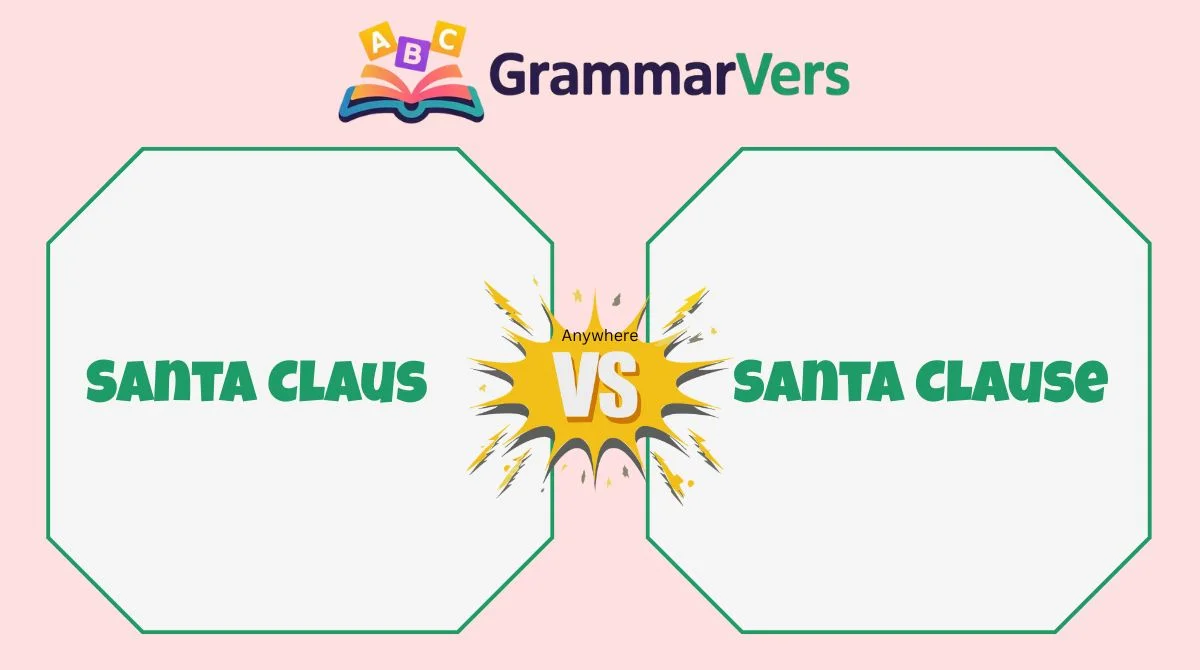
Difference Between Santa Clause and Santa Claus
This is where everything becomes clear.
Comparison Table
| Feature | Santa Clause | Santa Claus |
|---|---|---|
| Meaning | A grammar mistake or unrelated phrase | Christmas character |
| Correct usage | Rarely correct | Always correct for Christmas |
| Word type | Clause = grammar term | Proper noun |
| Capitalization | Not fixed | Always capitalized |
| Context | Grammar or legal writing | Holiday, stories, culture |
Usage Difference
- Santa Claus → Used in daily conversation, especially during Christmas
- Clause → Used in grammar or legal English
Grammar Logic
- Claus is a name (proper noun)
- Clause is a thing (noun in grammar)
So:
- You cannot replace a person’s name with a grammar term
Sentence Structure Difference
- Santa Claus is kind. ✅
- This clause is important. ✅
But:
- Santa clause is kind. ❌ (wrong meaning)
Meaning Comparison
- Santa Claus → A person (fictional)
- Clause → A part of a sentence
They are completely different concepts.
Grammar Rules You Must Remember
: “Santa Claus” is Always Capitalized
Because it is a name.
Example:
- ✅ Santa Claus is coming.
- ❌ santa claus is coming.
: “Clause” Belongs to Grammar
Use it only when talking about sentences.
Example:
- This clause is dependent.
: Never Replace “Claus” with “Clause”
Even if they sound similar.
Example:
- ❌ Santa Clause gave me a gift.
- ✅ Santa Claus gave me a gift.
: Check Context Before Writing
Ask yourself:
- Am I talking about Christmas? → Use Santa Claus
- Am I talking about grammar? → Use clause
Example:
- We studied a clause in class.
- Santa Claus visited our school.
Common Mistakes Students Make
Why Mistakes Happen
- Similar pronunciation
- Spelling confusion
- Lack of grammar knowledge
- Fast typing or auto-correct errors
Wrong vs Correct Examples
❌ Santa Clause is coming.
✅ Santa Claus is coming.
❌ I saw santa claus yesterday.
✅ I saw Santa Claus yesterday.
❌ This Santa Claus has two verbs.
✅ This clause has two verbs.
Easy Correction Tips
- Remember: Clause = grammar
- Remember: Claus = Christmas man
- Always check spelling before writing
- Read your sentence again
Easy Trick to Remember the Difference
Here’s a simple trick:
👉 Claus has “u” like “fun” → Christmas is fun!
👉 Clause has “e” like “sentence” → grammar sentence
Another way:
- Claus → Person
- Clause → Part of a sentence
Think like this:
- If he gives gifts → Claus
- If it has a subject and verb → Clause
This small trick helps a lot.
Daily Life Examples
Here are simple spoken English sentences:
- Did you see Santa Claus at the mall?
- My kids are waiting for Santa Claus.
- Santa Claus will come at night.
- I dressed like Santa Claus.
- She believes in Santa Claus.
- This sentence has one clause.
- Add another clause to this sentence.
- The teacher explained the clause again.
- Santa Claus gave me a toy.
- That clause is very confusing.
These examples show how both words are used in real life.
Practice Section
Choose the correct option:
- ___ is coming tonight.
a) Santa Clause
b) Santa Claus - This sentence has two ___.
a) Claus
b) Clauses - I saw ___ yesterday.
a) Santa Claus
b) Santa Clause - A ___ must have a verb.
a) Clause
b) Claus - Children love ___.
a) Santa Clause
b) Santa Claus
Answers
- b) Santa Claus
- b) Clauses
- a) Santa Claus
- a) Clause
- b) Santa Claus
FAQs
1. What is the difference between Santa Clause and Santa Claus?
Santa Claus is the Christmas character. Clause is a grammar term. “Santa Clause” is usually a spelling mistake.
2. Can we use “Santa Clause” in English?
Not in normal situations. It is considered incorrect when talking about Christmas. Use “Santa Claus” instead.
3. Is “clause” a grammar word?
Yes. A clause is a group of words with a subject and a verb. It is an important part of sentence structure.
4. Why do people confuse Claus and clause?
They sound similar. Also, learners may not know the spelling difference or meaning clearly.
5. Is Santa Claus a proper noun?
Yes. It is a name, so it must always be capitalized.
6. Can “clause” be plural?
Yes. The plural form is “clauses.”
Example: This paragraph has three clauses.
Final Conclusion
The difference between Santa Clause and Santa Claus is simple once you understand it clearly. One small letter changes everything.
Santa Claus is the friendly Christmas character loved by children around the world. On the other hand, clause is a grammar term used to describe a part of a sentence.
Most mistakes happen because the words sound alike. But their meanings are completely different. If you remember that “Claus” is a person and “clause” is part of a sentence, you will avoid this error easily.
Practice writing and reading both words in context. Pay attention to spelling, especially in exams and daily writing. Over time, this confusion will disappear.
Keep learning, stay curious, and enjoy improving your English step by step.