Many English learners feel confused when they see sentences with extra information in the middle. Sometimes there are commas, sometimes there are none.
Sometimes removing a part changes the meaning, and sometimes it doesn’t. This confusion often comes from not understanding restrictive modifiers.
This topic may sound difficult, but it is actually very practical. You use it every day when you describe people, places, or things.
For example, when you say “the boy who is wearing a red shirt”, you are using a restrictive modifier without even thinking about it.
Understanding this concept helps you write clearer sentences. It also helps you avoid common grammar mistakes, especially with commas.
Many learners either add commas everywhere or forget them completely. Both can change the meaning of a sentence.
After reading this guide, you will clearly understand what restrictive modifiers are, how they work, and how they are different from non-restrictive modifiers.
You will also learn simple rules, real-life examples, and easy tricks to remember everything.
What Does “Restrictive” Mean?
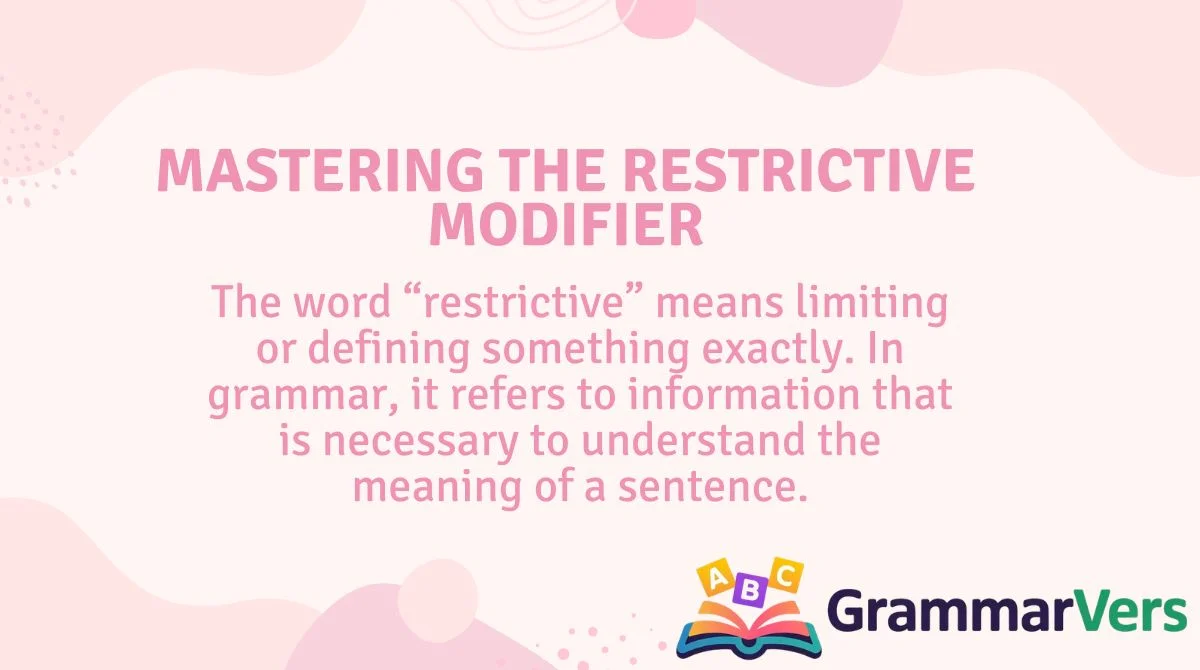
The word “restrictive” means limiting or defining something exactly. In grammar, it refers to information that is necessary to understand the meaning of a sentence.
A restrictive part of a sentence tells us exactly which person or thing we are talking about. Without it, the sentence would be unclear or incomplete.
Simple Definition:
A restrictive modifier gives essential information. You cannot remove it without changing the meaning.
When Do We Use It?
We use restrictive modifiers when:
- There are many possible options
- We need to specify exactly one
- The sentence would be unclear without it
Grammar Rule:
- No commas are used with restrictive modifiers
Examples:
- The book that is on the table is mine.
- Students who study regularly get better results.
- The car that he bought yesterday is very fast.
- People who eat healthy food feel better.
- The teacher who teaches math is strict.
- The dog that barked all night kept me awake.
- The girl who is singing is my sister.
- The phone that I lost was expensive.
Common Learner Confusion:
Many learners think all extra information needs commas. That’s not true. If the information is necessary to identify something, it is restrictive and should not have commas.
What Does “Modifier” Mean?
A modifier is a word or group of words that gives more information about something. It “modifies” or describes a noun.
Modifiers help make sentences more interesting and clear.
Simple Definition:
A modifier adds detail or description to a noun.
When Do We Use It?
We use modifiers to:
- Describe people or things
- Give extra details
- Make sentences clearer
Grammar Rule:
Modifiers often come:
- After a noun (especially in clauses)
- Before a noun (as adjectives)
Examples:
- The tall boy is my friend.
- The house with a blue door is ours.
- The woman who is talking is my aunt.
- I like food that is spicy.
- The man wearing a hat is my uncle.
- The movie that we watched was funny.
- The girl with long hair is a singer.
- The cake on the table looks delicious.
Common Learner Confusion:
Learners often mix up:
- Necessary information (restrictive)
- Extra information (non-restrictive)
They also forget that modifiers can be short or long.
Difference Between Restrictive and Non-Restrictive (Detailed)
Understanding this difference is the key to mastering the restrictive modifier.
| Feature | Restrictive Modifier | Non-Restrictive Modifier |
|---|---|---|
| Importance | Essential | Extra information |
| Commas | No commas | Uses commas |
| Meaning | Changes meaning if removed | Meaning stays the same |
| Purpose | Identifies exactly | Adds extra detail |
| Example | The boy who is running is my brother | My brother, who is running, is fast |
Usage Difference
- Restrictive: Needed to identify the noun
- Non-restrictive: Just gives extra detail
Example:
- The students who passed the exam are happy.
(Only some students passed) - The students, who passed the exam, are happy.
(All students passed)
Grammar Logic
Restrictive modifiers answer questions like:
- Which one?
- Which person?
- Which thing?
Non-restrictive modifiers answer:
- Extra information about it
Sentence Structure Difference
- Restrictive:
→ No commas
→ Direct connection to noun - Non-restrictive:
→ Commas before and after
→ Can be removed easily
Meaning Comparison
Restrictive:
The car that is red is mine.
→ Only the red car is mine.
Non-restrictive:
My car, which is red, is fast.
→ I have only one car. It happens to be red.
Grammar Rules You Must Remember
Rule #1: No Commas in Restrictive Modifiers
Correct:
The book that I bought is interesting.
Wrong:
The book, that I bought, is interesting.
Rule #2: Use “that” for Restrictive Clauses (Often)
Correct:
The movie that we watched was great.
“Which” is usually used for non-restrictive clauses.
Rule #3: Information Must Be Essential
Correct:
The man who called you is here.
Without this part, we don’t know which man.
Rule #4: Do Not Remove It
Correct:
The house that has a garden is expensive.
If removed:
“The house is expensive” → unclear meaning
Common Mistakes Students Make
1. Using Commas Incorrectly
❌ The boy, who is playing, is my brother.
✅ The boy who is playing is my brother.
Why?
Because it tells us which boy.
2. Using “which” Instead of “that”
❌ The book which I read was good.
✅ The book that I read was good.
3. Removing Important Information
❌ The teacher is strict.
(Which teacher?)
✅ The teacher who teaches English is strict.
4. Overusing Non-Restrictive Form
Learners often add commas because they think it sounds more formal.
Tip: If removing the clause changes meaning → no commas.
Easy Trick to Remember the Difference
Think of it like this:
👉 Restrictive = Needed to identify
👉 Non-restrictive = Extra information
Simple Memory Trick:
Ask yourself:
“Can I remove this part and still understand the sentence?”
- If NO → Restrictive
- If YES → Non-restrictive
Real-Life Logic:
Imagine you are in a classroom with 10 students.
You say:
“The student who is wearing glasses”
Now everyone knows exactly who.
That is restrictive.
Daily Life Examples (Very Important)
These are simple sentences you can hear in daily conversations:
- The person who called you is waiting outside.
- I like movies that make me laugh.
- The shop that sells fresh bread is closed today.
- The friend who helped me is very kind.
- The phone that I bought last week is broken.
- People who exercise daily feel more active.
- The bag that you left here is mine.
- The teacher who explains clearly is popular.
- The student who asked the question was right.
- The place that we visited was beautiful.
Practice Section
Choose the correct sentence:
A) The book, that I read, was boring.
B) The book that I read was boring.
A) The boy who is crying needs help.
B) The boy, who is crying, needs help.
A) The car which I bought is new.
B) The car that I bought is new.
A) The teacher, who teaches math, is strict.
B) The teacher who teaches math is strict.
A) The food that we ate was delicious.
B) The food, that we ate, was delicious.
Answers:
- B
- A
- B
- B
- A
FAQs
1. What is the difference between restrictive and non-restrictive modifiers?
Restrictive modifiers are necessary for meaning and do not use commas. Non-restrictive modifiers add extra information and use commas.
2. Can we use restrictive modifiers in questions?
Yes, you can. For example:
“Do you know the person who called me?”
3. Is “that” always used in restrictive modifiers?
Often yes, especially in informal English. But “who” is used for people.
4. Can I remove a restrictive modifier?
No. If you remove it, the meaning becomes unclear or changes completely.
5. Why are commas not used in restrictive modifiers?
Because the information is essential. Commas are used only for extra, non-essential details.
6. Is this topic important for writing?
Yes, very important. It helps you write clearly and avoid confusion in both speaking and writing.
Final Conclusion
Understanding restrictive modifiers can completely change how clearly you speak and write English. It may feel confusing at first, especially when commas are involved, but with practice, it becomes natural.
The key idea is simple: if the information is necessary to identify something, it is restrictive and does not need commas. If it is just extra detail, then commas are used.
Try to notice these patterns in everyday English. Listen to how people speak and look at how sentences are written. Practice by making your own sentences and checking if the meaning changes when you remove the modifier.
With time, you will not need to think too hard about it. It will become part of your natural English. Keep practicing, stay curious, and don’t worry about small mistakes—they are part of learning.