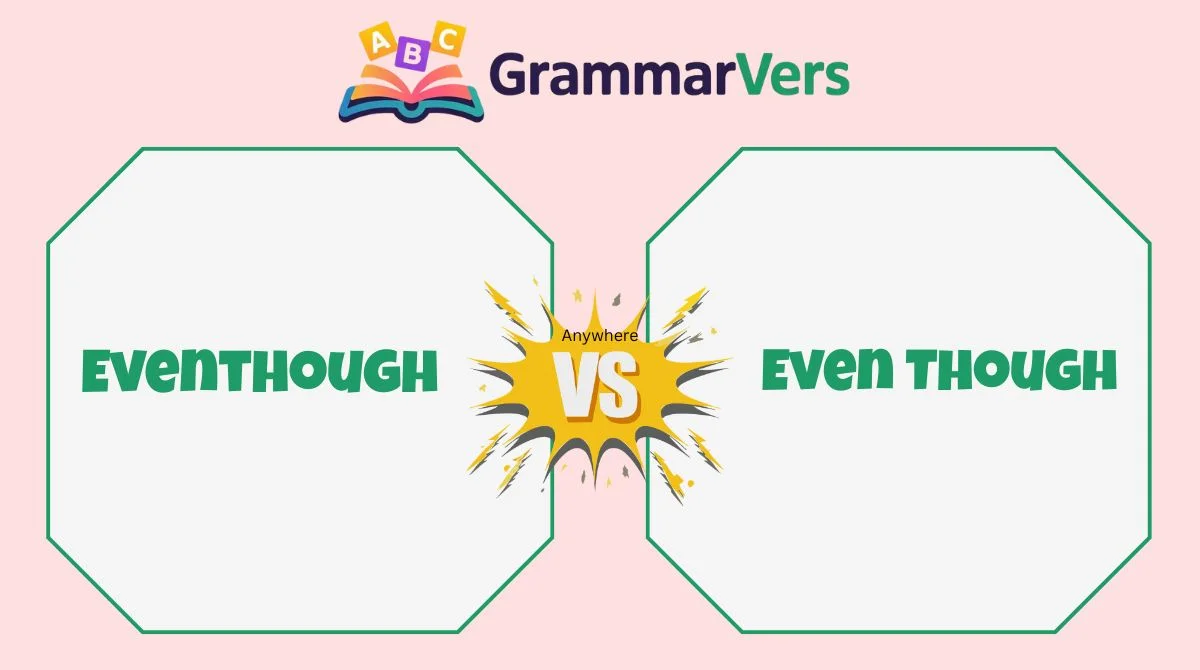
Many English learners stop for a moment when they see words like even though and eventhough. They look almost the same, so it feels natural to think both are correct. But here’s the truth: one of them is correct English, and the other is not.
This confusion happens because spoken English often blends words together. When people speak quickly, even though can sound like one word.
So learners sometimes write it as eventhough. That’s a very common mistake, especially for beginners and non-native speakers.
Understanding this topic is important because even though is used very often in daily conversations. You’ll hear it in movies, songs, and everyday speech. It helps you connect ideas and show contrast, which is a key part of good communication.
By the end of this guide, you will clearly understand:
- Which form is correct
- How to use even though properly
- Why eventhough is incorrect
- How to avoid common mistakes
Everything is explained in simple, clear English with real-life examples. No confusing grammar terms—just practical learning you can use right away.
What Does “Even Though” Mean?
Simple Definition
Even though is used to show contrast or surprise. It means something happened, but the result is different from what you expect.
In simple words:
👉 It means “despite the fact that” or “although”
When to Use It
You use even though when:
- Two ideas are different or opposite
- The second idea is surprising
Grammar Rule
Even though is a conjunction, which means it connects two parts of a sentence.
Structure:
- Even though + subject + verb, main clause
OR - Main clause + even though + subject + verb
Example Sentences
- Even though it was raining, we went outside.
- She smiled even though she was tired.
- Even though he studied a lot, he failed the test.
- I enjoyed the movie even though it was long.
- Even though they are rich, they live simply.
- He kept working even though he felt sick.
- Even though the food was cold, I ate it.
- She went to school even though she had a headache.
Common Learner Confusion
Many learners think even though is just a stronger version of though or although. That is partly true, but the key idea is emphasis.
- Though = normal contrast
- Even though = stronger contrast (more surprising)
Example:
- Though he was tired, he worked.
- Even though he was tired, he worked. ✅ (more emphasis)
What Does “Eventhough” Mean?
Simple Definition
Eventhough is not a correct English word.
It is simply a spelling mistake of even though.
When to Use It
You should never use “eventhough” in correct writing.
It may appear:
- In informal chats
- In beginner writing
- In fast typing mistakes
But in proper English, it is always wrong.
Grammar Rule
There is no grammar rule for eventhough because:
👉 It is not a real word in standard English.
Correct form:
✔ even though
❌ eventhough
Example Sentences (Incorrect vs Correct)
- ❌ Eventhough it rained, we went out.
✔ Even though it rained, we went out. - ❌ I like her eventhough she is strict.
✔ I like her even though she is strict. - ❌ Eventhough he was late, he joined the meeting.
✔ Even though he was late, he joined the meeting. - ❌ Eventhough I was scared, I tried.
✔ Even though I was scared, I tried. - ❌ Eventhough she is young, she is wise.
✔ Even though she is young, she is wise. - ❌ Eventhough they lost, they were happy.
✔ Even though they lost, they were happy.
Common Learner Confusion
Why do students write eventhough?
- It sounds like one word when spoken
- Similar words exist (e.g., although)
- Typing quickly without thinking
But remember:
👉 English keeps even though as two separate words
Difference Between Even Though and Eventhough (Detailed)
Comparison Table
| Feature | Even Though | Eventhough |
|---|---|---|
| Correct English | ✅ Yes | ❌ No |
| Type | Conjunction | Not a real word |
| Usage | Shows contrast | Should not be used |
| Writing form | Two words | Incorrect combined form |
| Accepted in exams | Yes | No |
Usage Difference
- Even though is used in correct sentences
- Eventhough should never be used in formal or correct writing
Grammar Logic
Even though is made of two words:
- Even (adds emphasis)
- Though (shows contrast)
Together, they form a stronger contrast expression.
Eventhough has no meaning because it is not a valid word.
Sentence Structure Difference
Correct:
- Even though + clause, result
- Result + even though + clause
Incorrect:
- Eventhough + anything ❌
Meaning Comparison
- Even though → shows contrast clearly
- Eventhough → no meaning
Grammar Rules You Must Remember
: Always Write It as Two Words
✔ Even though
❌ Eventhough
Example:
Even though she was busy, she helped me.
: It Must Be Followed by a Full Clause
You need a subject and a verb after it.
✔ Even though he was tired, he continued.
❌ Even though tired, he continued. (incorrect for beginners)
: Use It to Show Contrast
The two ideas should be different or surprising.
Example:
Even though it was expensive, I bought it.
: It Can Come at the Beginning or Middle
Both are correct.
Beginning:
Even though it was cold, we went out.
Middle:
We went out even though it was cold.
Common Mistakes Students Make
1. Writing It as One Word
❌ Eventhough
✔ Even though
Tip: Always separate the words.
2. Using It Without Contrast
❌ Even though I like tea, I drink tea.
✔ Even though I like tea, I drink coffee.
Tip: Make sure the ideas are different.
3. Missing Subject or Verb
❌ Even though tired, he worked.
✔ Even though he was tired, he worked.
Tip: Use a full sentence after it.
4. Overusing It
Using even though in every sentence can sound unnatural.
Tip: Use other words too:
- Although
- Though
- But
Easy Trick to Remember the Difference
Here’s a simple trick:
👉 Think: “Even + Though = Two words, always!”
If you can separate them when speaking, you must separate them when writing.
Another tip:
- If you can replace it with although, it’s correct.
Example:
- Even though it rained → Although it rained ✅
If the word looks strange as one word (eventhough), it’s wrong.
Daily Life Examples (Very Important)
These are real-life style sentences you might hear:
- Even though I was tired, I stayed up late.
- I went to work even though I felt sick.
- Even though she is young, she speaks well.
- He smiled even though he was upset.
- Even though it was hot, we played football.
- I helped him even though he didn’t ask.
- Even though the shop was closed, we waited.
- She came even though she had a lot of work.
- Even though I don’t like coffee, I drink it sometimes.
- We enjoyed the trip even though it was short.
These are simple and natural. You can use them in daily conversation.
Practice Section
Choose the correct option:
- ______ it was raining, we went outside.
a) Eventhough
b) Even though - I like him ______ he is strict.
a) eventhough
b) even though - ______ she was tired, she finished her work.
a) Even though
b) Eventhough - He came to class ______ he was sick.
a) even though
b) eventhough - ______ they lost, they were happy.
a) Eventhough
b) Even though
Answers
- b) Even though
- b) even though
- a) Even though
- a) even though
- b) Even though
FAQs
1. What is the difference between even though and eventhough?
Even though is correct and used to show contrast. Eventhough is incorrect and not a real English word. Always use two words.
2. Can we use even though in questions?
Yes, but it is less common. It is mostly used in statements.
Example: Would you go even though it’s raining?
3. Is even though formal or informal?
It can be used in both formal and informal English. It is very common in speaking and writing.
4. Can I replace even though with although?
Yes, in most cases. Both show contrast.
Example: Even though it rained = Although it rained
5. Why do people write eventhough?
Because it sounds like one word in speech. It is a common spelling mistake, especially among learners.
6. Is “though” the same as “even though”?
Not exactly. Even though is stronger and shows more surprise or contrast than though.
Final Conclusion
The difference between even though and eventhough is actually very simple once you understand it clearly. One is correct English, and the other is just a common mistake.
Even though is a useful phrase that helps you connect ideas and show contrast. It makes your sentences richer and more natural. You’ll hear it in daily conversations, movies, and real-life situations all the time.
On the other hand, eventhough is not accepted in correct English writing. It happens because of fast speech or typing, but it should always be avoided, especially in exams, emails, and formal writing.
The key point to remember is this: always write it as two words—even though. Practice using it in simple sentences, and soon it will feel natural.
Keep practicing, keep noticing how native speakers use it, and don’t worry about small mistakes. That’s how real learning happens.