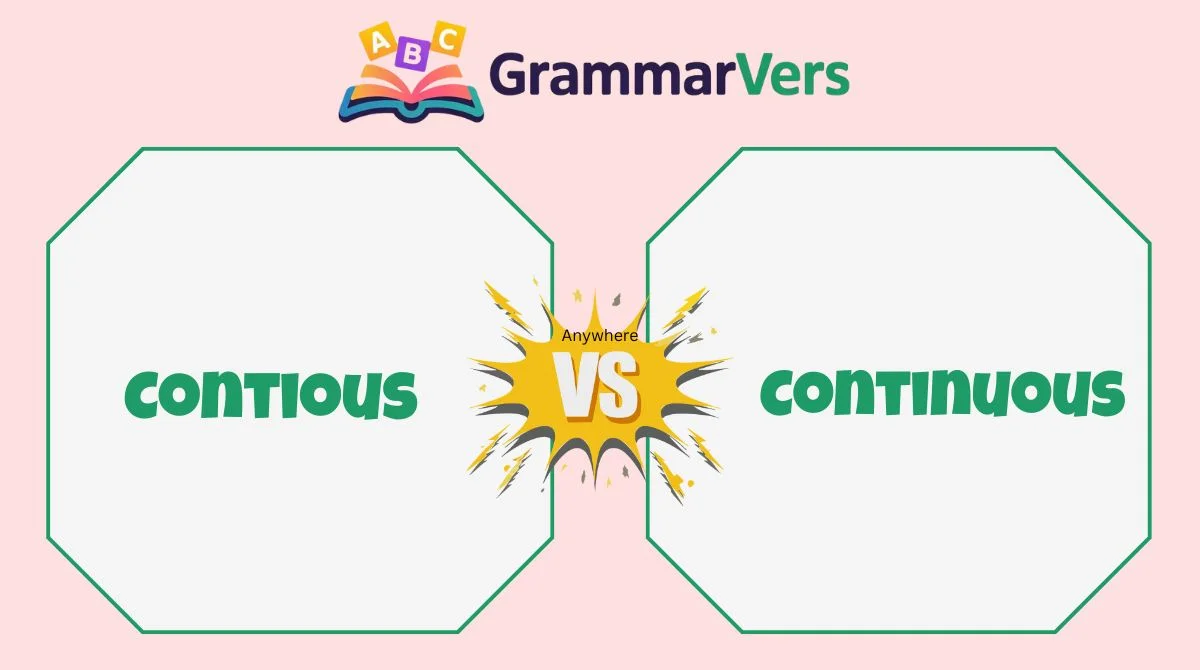
Many English learners get confused when they see words that look almost the same. One small spelling change can completely change the meaning—or sometimes, it creates a word that doesn’t even exist.
This is exactly what happens with “continuous” and “contious.”
At first glance, both words may seem correct. They sound similar when spoken quickly, and learners often type them without thinking twice.
But here’s the truth: only one of these words is actually correct in standard English.
This confusion is very common, especially for beginners and non-native speakers. It usually happens because of spelling habits, pronunciation mistakes, or simple typing errors.
Still, using the wrong form can make your writing look unprofessional or unclear.
Understanding the difference is important for daily English. Whether you are writing emails, speaking in class, or preparing for exams, correct spelling and usage matter a lot.
After reading this lesson, you will clearly understand:
- The real meaning of “continuous”
- Why “contious” is incorrect
- How to use the correct word in real-life situations
- Easy tricks to avoid mistakes forever
What Does “Continuous” Mean?
Simple Definition
The word “continuous” means something that happens without stopping or without a break.
It describes actions, events, or processes that keep going for a period of time.
When to Use It
You use “continuous” when:
- Something is happening all the time
- There is no pause or interruption
- The action flows smoothly from one moment to another
Grammar Rule
“Continuous” is an adjective.
It is used to describe nouns (things, actions, or situations).
Structure:
- continuous + noun
- be + continuous (in descriptive sentences)
Example Sentences
- The rain was continuous all night.
- She made continuous efforts to improve her English.
- There was continuous noise outside my room.
- The machine runs in a continuous cycle.
- He gave continuous support to his team.
- The teacher spoke in a continuous flow.
- The road had continuous traffic.
- Continuous learning helps you grow faster.
Common Learner Confusion
Many learners mix “continuous” with words like:
- continual
- constant
While they are similar, “continuous” specifically means no break at all.
Example:
- Continuous rain = no stopping
- Continual rain = stops and starts again
Also, some learners mistakenly spell it as “contious,” which is incorrect.
What Does “Contious” Mean?
Simple Definition
The word “contious” does not exist in English.
It is a misspelling of “continuous.”
When to Use It
You should never use “contious” in correct English writing or speaking.
If you see this word, it is almost always:
- A typing mistake
- A spelling error
- A misunderstanding of the correct word
Grammar Rule
Since “contious” is not a real English word:
- It has no grammar role
- It is not accepted in formal or informal English
Example Sentences (Incorrect Usage)
These examples show common mistakes:
- ❌ The rain is contious.
- ❌ She made contious progress.
- ❌ There is contious noise here.
- ❌ He works in a contious process.
- ❌ The machine runs contiously.
- ❌ I hear contious sounds.
- ❌ This is a contious problem.
- ❌ We need contious improvement.
✔ Correct version (replace with “continuous”):
- The rain is continuous.
- She made continuous progress.
Common Learner Confusion
Learners often write “contious” because:
- They drop letters while typing fast
- They are unsure about spelling
- They rely on pronunciation (which can be misleading)
Remember:
If your spell-check shows an error, it’s probably “continuous.”
Difference Between Continuous and Contious (Detailed)
Comparison Table
| Feature | Continuous | Contious |
|---|---|---|
| Is it a real word? | Yes | No |
| Meaning | Without stopping | No meaning |
| Part of speech | Adjective | Not applicable |
| Correct usage | Yes | Never |
| Common in writing | Very common | Spelling mistake |
| Example | Continuous effort is important | ❌ Incorrect word |
Usage Difference
- Continuous is used in both spoken and written English.
- Contious should never be used.
Grammar Logic
“Continuous” comes from the word continue + -ous
The suffix -ous turns a verb into an adjective.
Example:
- Continue → Continuous
- Danger → Dangerous
“Contious” breaks this structure, so it becomes incorrect.
Sentence Structure Difference
✔ Correct:
- She showed continuous improvement.
❌ Incorrect:
- She showed contious improvement.
Meaning Comparison
- Continuous → clear meaning (without stopping)
- Contious → no meaning at all
Grammar Rules You Must Remember
Rule #1: Always Use “Continuous” as an Adjective
Example:
- He made continuous progress in his studies.
Rule #2: Never Drop Letters While Spelling
Many learners write “contious” by skipping letters.
Example:
- ❌ contious
- ✔ continuous
Rule #3: Check the Root Word
If the word comes from “continue,” it must include all key letters.
Example:
- continue → continuous
Rule #4: Use Spell-Check When Writing
If you are unsure, use tools or read your sentence again.
Example:
- Incorrect: The process is contious.
- Correct: The process is continuous.
Common Mistakes Students Make
Why Mistakes Happen
- Fast typing
- Poor spelling habits
- Confusing pronunciation
- Lack of reading practice
Wrong vs Correct Examples
- ❌ contious work → ✔ continuous work
- ❌ contious rain → ✔ continuous rain
- ❌ contious sound → ✔ continuous sound
Easy Correction Tips
- Say the word slowly: con-ti-nu-ous
- Break it into parts
- Practice writing it daily
- Use it in sentences
Easy Trick to Remember the Difference
Here’s a simple trick:
👉 Think of the word “continue”
If something continues without stopping, it is continuous.
Now check:
- “Contious” does not match “continue”
- So it must be wrong
Another trick:
👉 “Continuous” has more letters because the action continues
Short word = wrong
Full word = correct
Daily Life Examples (Very Important)
These examples show how people use “continuous” in real conversations:
- I heard continuous noise from the street.
- She is making continuous progress in English.
- We had continuous rain yesterday.
- The baby cried in a continuous voice.
- He gave continuous support to his friend.
- There was continuous traffic on the road.
- The teacher talked in a continuous tone.
- I need continuous practice to improve.
- The fan makes a continuous sound.
- They worked for continuous hours.
Practice Section
Choose the correct word: continuous or contious
- The machine runs in a ______ process.
- She showed ______ improvement.
- There is ______ noise outside.
- He made ______ effort to succeed.
- The rain was ______ all day.
Answers
- continuous
- continuous
- continuous
- continuous
- continuous
(“Contious” is never correct.)
FAQs
1. What is the difference between continuous and contious?
“Continuous” is a correct English word that means without stopping. “Contious” is just a spelling mistake and has no meaning.
2. Can we use contious in informal English?
No, you should never use “contious,” even in casual writing. It is always considered incorrect.
3. Why do people write contious instead of continuous?
People often make this mistake because they type quickly or are unsure about spelling. It is a very common error.
4. Is continuous a formal or informal word?
“Continuous” can be used in both formal and informal English. It is a standard and widely used word.
5. How can I remember the correct spelling of continuous?
Think of the word “continue.” Add “-ous” at the end. This will help you remember the correct form.
6. Can continuous be used in speaking?
Yes, it is commonly used in speaking and writing. It is a basic and important English word.
Final Conclusion
Small spelling mistakes can create big confusion, and “continuous vs contious” is a perfect example of that. One is a correct and useful word, while the other is simply an error that should be avoided.
“Continuous” is an important adjective used in daily English to describe actions that do not stop. You will hear it in conversations, see it in books, and use it in writing.
On the other hand, “contious” has no place in correct English, no matter the situation.
The good news is that this mistake is very easy to fix. Once you connect “continuous” with the root word “continue,” everything becomes clear.
Practice writing it, say it slowly, and use it in real sentences. Over time, it will feel natural.
Keep learning step by step. Even small improvements like this can make your English stronger and more confident.